Issue Brief:
What Happened: The Strikes and Capture of Maduro
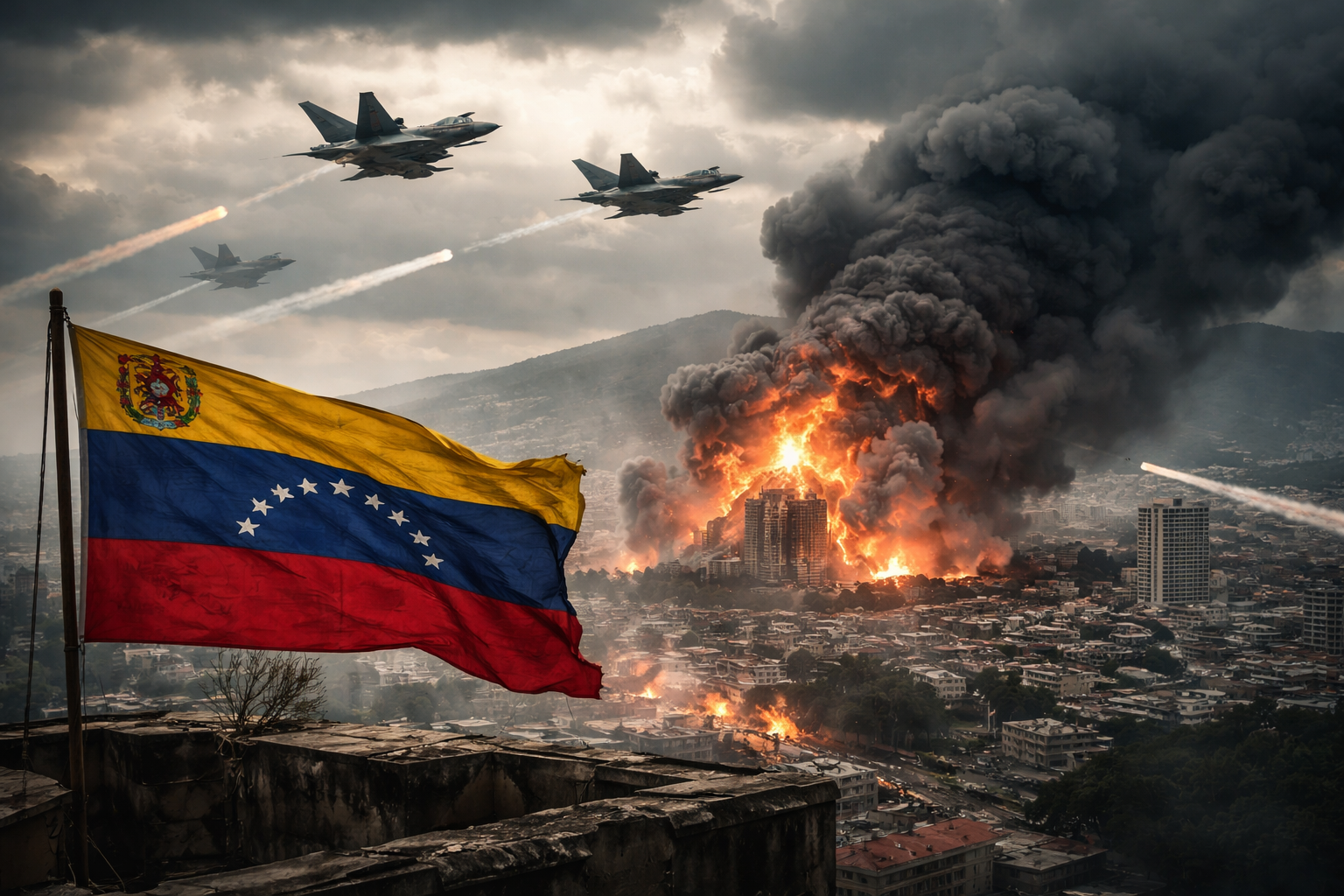
On January 3, 2026, the United States carried out large-scale military strikes on Venezuela, including the capital Caracas and surrounding regions. Explosions were reported early in the morning, air activity was observed over major urban centres, and widespread power outages were recorded. In a widely circulated statement, U.S. President Donald Trump announced that Venezuelan President Nicolás Maduro and his wife, Cilia Flores, had been “captured and flown out of the country”, citing allegations that Maduro oversaw narcotics trafficking and transnational criminal networks.
The U.S. characterized its action as part of a broader operational effort against alleged narcotics networks and cartel structures tied to Venezuelan state actors. Caracas vehemently rejected the U.S. narrative, describing the strikes as military aggression and a grave violation of national sovereignty. The Venezuelan government declared a national emergency and mobilised security forces across the country.
Historical Context: U.S.–Venezuela Relations and Latin American Interventionism
U.S.–Venezuela relations have remained deeply adversarial since the presidency of Hugo Chávez (1999–2013). The ideological clash between Chávez’s Bolivarian socialism and U.S. strategic interests became pronounced over issues of energy control, regional alliances such as ALBA, and overt anti-U.S. rhetoric. Under Nicolás Maduro, these tensions intensified further amid Venezuela’s economic collapse, humanitarian crisis, and internationally contested elections. The United States has repeatedly accused Maduro’s government of corruption, repression, and electoral fraud.
Over the years, Washington imposed sweeping sanctions targeting Venezuela’s oil sector, state institutions, and senior government officials, significantly constraining the country’s economy.
Precursor Actions (2025)
Throughout 2025, U.S. involvement escalated beyond economic sanctions and diplomatic pressure. A Caribbean naval buildup and increased U.S. military presence were officially justified as efforts to combat international drug trafficking routes linked to Venezuela. The United States also publicised strikes on vessels allegedly transporting narcotics connected to the so-called “Cartel of the Suns”, which Washington claims has links to Venezuelan state actors. Simultaneously, several Venezuelan entities and officials were designated by the U.S. as terrorist or narco-terrorist actors, reinforcing the legal framing for coercive and military measures. These actions laid the groundwork for the January 2026 escalation, marking a shift from economic and maritime pressure to direct military intervention.
The Trump Administration’s Justifications and Narrative
The Trump administration framed the military operation through multiple overlapping justifications.
A. Combatting Narcotics Trafficking: U.S. officials argued that Venezuela had effectively become a “narco-state”, with elements of the government complicit in transnational drug trafficking. This claim was used to justify kinetic military operations under the guise of self-defense and international drug control mandates.
B. Regime Illegitimacy Narrative: Washington asserted that Maduro’s 2024 re-election lacked credibility and democratic legitimacy. This position was used to undermine Maduro’s sovereign authority and to rationalise external intervention.
C. National Security Framing: The administration repeatedly framed the operation as necessary for U.S. national security, often conflating criminal networks, governance failure, and geopolitical rivalry in its public messaging.
International Reaction: Broad Condemnation and Legal Concerns
The U.S. military action triggered widespread international condemnation. Brazil’s President Luiz Inácio Lula da Silva described the strikes as a violation of Venezuelan sovereignty and called for a strong response through the United Nations. China’s Foreign Ministry labelled the operation a blatant violation of international law and an example of hegemonic behaviour.
Iran condemned the strikes as unlawful aggression against a sovereign state. Colombia and Mexico warned that unilateral military action threatened regional stability and violated foundational principles of international relations.
The European Union urged restraint and respect for international law, despite its long-standing criticism of Maduro’s governance. Even close U.S. allies such as the United Kingdom emphasised the need for adherence to international legal norms and called for de-escalation.
International Law and Sovereignty Questions
Most international critiques are grounded in Article 2(4) of the UN Charter, which prohibits the threat or use of force against another state except in cases of self-defense or explicit UN Security Council authorization. Neither condition clearly applies in this case. International legal experts argue that drug trafficking, even if serious, does not constitute an “armed attack” that would justify cross-border military force under established international law.
Strategic Calculus: Resources, Power Projection, and Geopolitics
Venezuela possesses some of the largest proven oil reserves in the world, making it a long-standing focal point of global energy politics. Critics argue that the U.S. pressure campaign, framed in terms of democracy and counter-narcotics, also reflects deeper economic and strategic interests related to energy markets and global supply chains. Competition with China and Russia for influence in Venezuela has further intensified the geopolitical stakes.
Cold War-Style Geopolitics
Russia condemned the strikes as armed aggression, while China issued strong diplomatic opposition, underscoring the broader great-power contestation surrounding Venezuela. These reactions highlight Venezuela’s strategic importance as a partner for U.S. rivals and signal the erosion of Washington’s uncontested influence in the Western Hemisphere.
Regional Security and Domino Effects
Latin American security dynamics have been significantly unsettled by the strikes. Regional governments and organisations fear the operation may heighten refugee and migration flows, trigger armed resistance movements, and create space for non-state actors and external geopolitical intervention.
Democratic Norms and Hypocrisy Charges
The United States presents itself as a global champion of democracy, human rights, and the liberal international order. However, many observers view the forcible removal of a sitting head of state through military means as fundamentally incompatible with those professed values. Sanctions, political delegitimization, and unilateral coercion are widely perceived as double standards when contrasted with U.S. rhetoric on sovereignty and self-determination. Critics argue that such actions undermine the UN system, weaken non-aligned norms, and contradict Latin America’s post-Cold War preference for negotiated political solutions. This contradiction fuels narratives of neo-imperialism and hegemonic overreach, particularly across the Global South.
Implications and Future Outlook
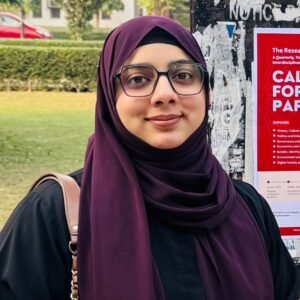
Long-Term Implications: Over the longer term, the strikes risk eroding international legal norms, normalising extra-legal regime change, and accelerating Venezuela’s strategic realignment toward Russia, China, and Iran. The authority of the UN Charter itself may be weakened if powerful states continue to act unilaterally without Security Council sanction. The U.S. strikes on Venezuela reflect deepening geopolitical rivalries, a long history of interventionism in Latin America, and a complex convergence of security, economic, and strategic interests. While Washington asserts counter-narcotics and security objectives, much of the international community views the operation as a breach of sovereignty and a serious challenge to international law. This episode starkly illustrates the tension between great-power politics and the normative foundations of the global order, particularly the principles of sovereignty, non-intervention, and peaceful dispute resolution. Wasia Khan is a PhD Scholar of International Relations and Area Studies at MMAJ Academy of International Studies, Jamia Millia Islamia, New Delhi. A graduate in Turkish Language and Literature, she also holds a Master’s in International Relations from the MMAJ Academy of International Studies of the same university. She is Deputy Executive Director of CDFA Research Foundation, and currently serves as the Director of the Division of Strategic & International Affairs.
Disclaimer: The opinions expressed in this article are solely those of the authors and do not necessarily reflect the views of CDFA or any affiliated organisation.
Conclusion
About the Author