
The September Shock: SCO’s Big Stage and America’s Bigger Tariff
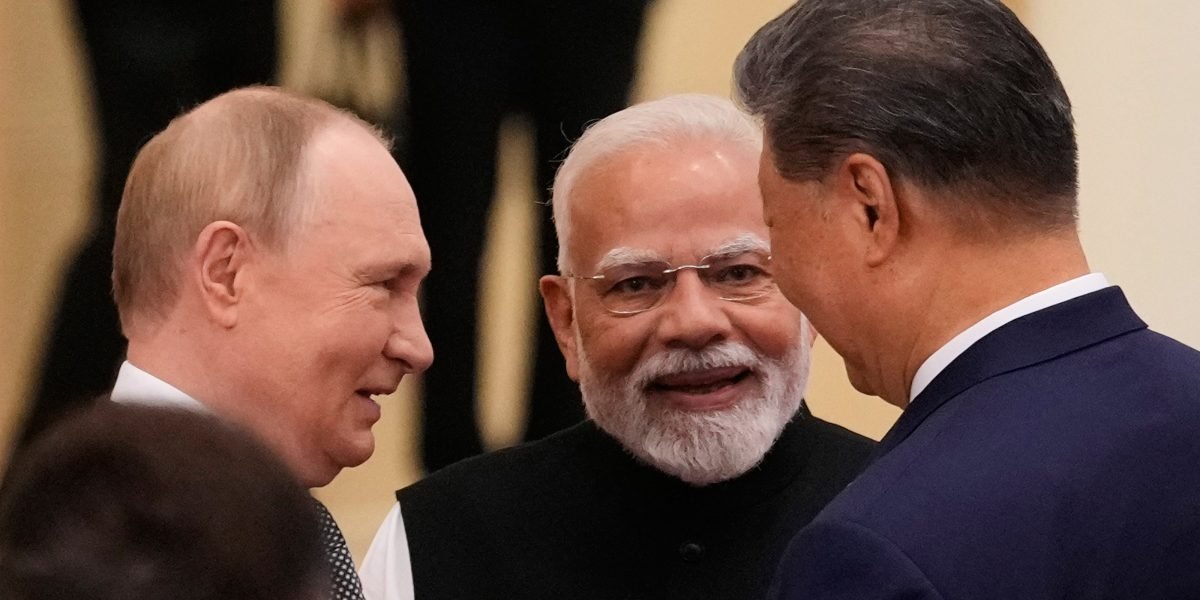
The 25th SCO Heads of State summit in Tianjin (September 1, 2025) was the most consequential SCO meeting in years. Xi Jinping framed the moment as a push for a new, more “Global South”-centered order, floated an SCO development bank, AI cooperation, and more non-dollar settlements. The optics were deliberate: Xi flanked by Putin and Modi, with the summit proclaiming long-horizon plans like a Development Strategy to 2035 and new institutional plumbing (from counter-drug to security coordination).
Delhi’s presence was not symbolic. India sent its prime minister; it backed language on connectivity with the now familiar Indian clause, respect for sovereignty and territorial integrity, a line that has consistently signaled New Delhi’s rejection of Belt and Road corridors that cut across Indian claims, notably the CPEC spur through Pakistan-occupied Kashmir. (Modi used similar formulations at earlier SCO settings; the Tianjin record shows India’s participation and the adoption of the “Tianjin Declaration” plus a 2035 Strategy, while passing the baton of 2025-26 SCO chairmanship to Kyrgyzstan.)
Now overlay the U.S. tariff shock: in August, Washington doubled tariffs on Indian goods to 50%, explicitly linking the move to India’s continued absorption of discounted Russian crude. That decision, taken under President Donald Trump’s revived tariff strategy, immediately created political space for Delhi to be seen with Moscow and Beijing without apology. Reuters and AP report the new tariff level and the political framing; a separate Wall Street Journal note highlights legal scrutiny around sweeping tariff authorities, but the immediate commercial effect on Indian exporters is clear.
India’s foreign minister S. Jai Shankar didn’t mince words: he called the tariff move “economically unsound” and vowed to defend Indian farmers and manufacturers, signaling that trade coercion would not pry Delhi away from its energy lifeline or its multi-alignment playbook.
Bottom line: the SCO summit offered a ready platform to demonstrate options; the U.S. tariff created the incentive to use it.
Is India “Getting Closer” to China and Russia, substantive or cosmetic?
With Russia, it’s substantively true. Energy trade and payments innovation have welded the partnership into a new configuration. India became Russia’s largest seaborne crude buyer in 2023–25; Russian oil has at times met roughly a third or more of India’s import basket, and Indian government data put FY 2024–25 India–Russia trade at a record high with imports from Russia dwarfing exports, illustrating both interdependence and imbalance. Those petroleum flows, and discussions on national-currency settlements, are structural, not episodic.
Defense linkages, while diversifying, remain weighty. SIPRI’s 2025 trend sheet still lists India as the largest destination for Russian arms in 2020–24 (about 38% of Russia’s exports), even as India leans harder into joint production, Western kit, and domestic manufacturing. This is a relationship being re-tooled, not replaced.
With China, it’s more “pseudo” than real, a managed thaw, not strategic embrace. Two facts anchor Indian policy: (1) the LAC crisis since 2020 and (2) a near-$100 billion trade deficit with China that India sees as strategically risky. The August 22, 2025 visit to Delhi by Wang Yi produced useful deliverables, resumption of direct flights, steps toward Kailash Mansarovar Yatra resumption, and a pledge to push disengagement talks, but India continues to insist that “border peace is a prerequisite” for normal ties. Commerce continues (and has recovered), but the deficit remains politically salient.
Verdict: Closer to Russia in material terms; tactically less cold with China, but still contested. The performance at Tianjin is best read as India signaling agency, not alignment.
What Exactly Happened at Tianjin, and Why It Matters
The Tianjin Declaration and associated outcomes matter for three reasons:
- Institutional Muscle: The SCO collectively endorsed a Strategy to 2035, considered new financial mechanisms (an SCO development bank), and pushed functional cooperation in areas like AI and anti-drug coordination. While these are not NATO-style commitments, they lay pipes for non-Western coordination, including non-dollar settlements, something Moscow and parts of Beijing’s policy community see as strategic insulation against U.S. sanctions and tariffs.
- Big-Tent Eurasia: SCO’s expansion continues: Belarus became a full member in 2024 at Astana; Laos was granted dialogue-partner status this year in Tianjin, and the CIS gained observer status—steady, if incremental, “big tent” building.
- India’s Seat at the Table: Delhi used the summit to (a) re-state its sovereignty caveats on connectivity, (b) push counter-terror language, and (c) preserve room to talk directly to both Putin and Xi in a multilateral setting, valuable given U.S. tariff heat and the need to manage the border. The MEA readout confirms the Modi-Xi conversation in Tianjin and the resumed working channels.
In other words, SCO is not India’s “bloc”, but it is a convenient continental stage at a time when seaborne coalitions (like the QUAD) are also evolving.
The U.S. Tariff War: How It Lands in India
The U.S. decision to raise tariffs on Indian goods to 50% is not a pinprick; it’s a structural shock with four immediate implications:
- Export Margin Compression: Sectors with mid-to-low value-add—apparel, certain engineering goods, some processed chemicals—will feel the squeeze first. Even firms with U.S. plants will face planning uncertainty until legal challenges (already underway in U.S. courts) clarify the scope and durability of presidential tariff powers.
- Trade Diversion & Round-Tripping Risk: Expect some re-routing via third countries and greater use of India–UAE and India–EU corridors to soften the blow. But the U.S. is tightening rules-of-origin checks, so circumvention space is narrowing. (Indian officials have said publicly the tariffs are “unsound,” but are preparing sectoral cushions.)
- Energy/Payments Politics: Washington has explicitly linked the tariff hit to India’s Russian oil offtake. That turns refinery economics into geopolitics and incentivizes Delhi to diversify payment rails—including rupee-dirham/dollar-adjacent workarounds—precisely the kind of experimentation that SCO and BRICS forums now encourage.
- Strategic Optics: The tariff wall undercuts the storyline of the U.S. as India’s “trusted reshoring” partner, even if U.S.–India technology and defense ties continue. Politically, it lowers the cost for India to be seen with Russia and China in multilateral rooms, without changing Delhi’s hard security calculus in the Indo-Pacific.
Net effect: tariffs nudge, they don’t rewrite, Indian strategy. But they do accelerate India’s search for redundant partners, payments, and markets, and make SCO-and-BRICS plumbing more relevant in practice.
Will a Closer SCO Track Challenge the U.S. and Its Anti-China Policy?
Indirectly, yes, by erosion rather than collision.
- Sanctions/Payments Resilience: If the SCO’s proposed development bank and banking consortium lending deepen, and if members expand local-currency settlements, the reach of U.S. financial statecraft is incrementally diluted. That’s not an overnight “alternative order,” but it matters over a decade. Russia is already settling more with India outside dollar rails; China has the scale to pilot AI plus fintech arrangements inside the bloc.
- Energy Re-routing: SCO’s largest economies, China and India, are the swing buyers of Russian oil. Their continued purchases constrain the ceiling of Western sanctions. That reality blunts the coercive edge of Washington’s anti-Russia and, by extension, anti-China economic policy architecture.
- Narrative Space: Forums like SCO and BRICS offer a megaphone for Beijing and Moscow to frame the West as “hegemonic” and themselves as pluralist. The Tianjin stagecraft was precisely about this narrative. India doesn’t endorse that script, but by sharing the stage, it complicates U.S. coalition messaging.
However, India’s presence is also a brake on anti-U.S. consolidation: Delhi can soften language, insert sovereignty caveats, and block any drift toward a military cast. India’s “inside voice” in Eurasian forums is precisely how it prevents a neat China-Russia bloc from vacuuming the neighborhood.
Is parallel engagement with QUAD and SCO a viable strategy for India?
It already does, and will continue to, by compartmentalizing:
- QUAD is for the maritime-tech commons: The 2025 Quad Foreign Ministers’ readout kept focus on maritime domain awareness, cyber, resilient supply chains, critical tech, and HADR, not a mutual defense pact. India’s long-standing line, “Quad is not against anyone”, remains policy, and it gives Delhi maneuver space to keep China-facing hard power mostly bilateral (U.S.–India exercises, logistics pacts) while keeping Quad public goods-oriented.
- SCO is for continental risk management: Terror networks, narcotics, Afghan spillovers, Central Asian energy and transport corridors, all sit squarely in SCO’s wheelhouse. India uses SCO to (a) talk to Pakistan without bilateral fanfare; (b) press counter-terror norms in a forum where Beijing and Moscow sit; and (c) keep a listening post on Central Asia and Russia.
This division of labor works because the pillars are functional, not ideological: QUAD for the Indo-Pacific commons; SCO for Eurasian stability mechanics. That’s how India will keep both plates spinning.
The China-Pakistan Factor: The Hardest Square of the Circle
Here lies India’s sharpest friction with China, and where the “getting closer” narrative breaks down.
- UN Listings Politics: China has repeatedly blocked or delayed India-backed moves to sanction Pakistan-based terrorists at the UN 1267 committee, cases from Masood Azhar earlier to Sajid Mir and others more recently. Indian media and The Economic Times/NDTV reporting this summer pointed to five Pakistan-based operatives and the TRF case facing Chinese objections; while some designations have eventually gone through (e.g., Abdul Rehman Makki in 2023), the pattern of procedural veto remains a live irritant.
- All-Weather Beijing–Islamabad: 2025 opened with a China–Pakistan joint statement reaffirming mutual support on “core interests” and accelerating CPEC-II, with fresh investment pledges announced again this week during Shehbaz Sharif’s Beijing trip tied to the SCO gathering. This is not theater; it is the backbone of China’s continental projection toward the Arabian Sea.
- Post-Pahalgam Narrative: After the April 2025 terrorist attack in Kashmir, Indian narratives hardened on Pakistani culpability (which Islamabad denies), while Beijing called for dialogue and deepened political messaging of support for Pakistan’s sovereignty and security. For Delhi, this underscores the limits of any “reset” with China.
How does India manage this? Three ways:
- Border–Terror Linkage: Keep insisting, in public and private, that border peace and counter-terror seriousness are prerequisites for broader normalization. (The August Wang Yi visit shows Delhi will take practical steps, flights, pilgrimages, but without conceding on core security issues.)
- Multilateral Friction Management: Use SCO counter-terror working groups and BRICS channels to socialize Indian dossiers, even if consensus texts are watered down. Every dossier tabled raises the reputational cost for blockers.
- Quiet Bilaterals with Washington: Even amid tariff spats, India keeps the intelligence and CT pipelines with the U.S. warm, because that’s where sanctions design, designation evidence, and tech tools move fastest. (This is one area where QUAD-adjacent trust remains high.)
Historical Continuum: Strategic Autonomy over Non-Alignment
The 1971 Indo-Soviet Treaty anchored the Cold War-era tilt; the 2005 U.S.–India civil nuclear deal and the subsequent defense agreements tilted India westward on technology and exercises; 2017 brought India into the SCO as a full member; 2020 Galwan froze India–China ties; 2022–25 energy politics with Russia redrew the map again. Through these swings, the constant has been sovereign optionality, what Jai Shankar has popularized as multi-alignment.
Today’s iteration is harsher and more pragmatic: energy with Russia, de-risked trade with China, technology and defense with the U.S. and allies, and an all-sides push for manufacturing and payments resilience.
The Economics Under the Hood: What the Data Say
India–China Trade: Bilateral trade remains huge, but the deficit is politically explosive, nearly $100 billion in 2024 by Reuters’ tally drawing on Chinese customs, with India seeking production-linked incentives and tariff/standards tools to indigenize electronics, solar, and APIs. This undercuts any claim of “embrace”; it’s structured dependency plus pushback.
India–Russia Trade: AP’s reporting cites Indian government data showing $68.7 billion in 2024–25 trade, with imports (mostly oil) around $64 billion vs exports of $5 billion, a lopsided but vital flow for India’s inflation management. The political price is U.S. irritation, now monetized via tariffs.
Payments & Logistics: The SCO’s flirtation with a bank and non-dollar settlement expands the canvas on which India already paints, rupee, dirham and other hybrid invoicing, private-sector bank hedges, and central bank-to-central bank conversations. Delhi likes redundancy, not replacement of the dollar, but insurance against the next shock.
What India Did at the SCO And What It Didn’t
India did:
- Show up at leader level and keep Eurasian lines warm when U.S. tariffs raised costs;
- Restate sovereignty principles on connectivity in a room that includes BRI’s architects;
- Work the Russia track, a Modi-Putin meeting and warm optics that underscore a special relationship when Delhi needs cheap energy;
- Keep China channels open, Modi–Xi in-person contact for the first time in years, then an MEA-managed process to restore direct flights and pilgrimage access.
India did not:
- Sign onto anti-U.S. rhetoric beyond generic “hegemonism” boilerplate;
- Endorse BRI/CPEC; or
- Soften its line on cross-border terrorism.
This is classic India-at-SCO: Attend, amend, and avoid enmeshment.
Managing QUAD and SCO in Parallel: A Playbook
Functional Firewalls: Keep QUAD on maritime awareness, tech standards, HADR, underlining it’s not a military alliance. State Department and DFAT readouts this year preserve that framing. Meanwhile, push SCO on terror, narcotics, Afghan spillovers, areas where even China prefers stability.
Issue-based Coalitions: On semiconductors or critical minerals, India works with the U.S., Japan, and Australia; on oil, fertilizers, payments, it works with Russia and the Gulf; on Central Asia transit, it talks inside SCO while piloting alternatives like Chabahar with Iran (and separately securing carve-outs from sanctions where possible).
Narrative Consistency: Publicly repeat the three mantras: (a) sovereignty/territorial integrity, (b) no tolerance for terror, (c) border peace prerequisite, so neither SCO nor QUAD partners misread India’s red lines.
The Pakistan Piece: Calibrated Pressure, Calibrated Calm
India knows China’s “all-weather” with Pakistan won’t change soon; CPEC-II is moving again, with Beijing extracting stronger security assurances after repeated attacks on Chinese workers. Delhi, in turn, will:
- Keep up UN designations pressure, even if China stalls, because every filing builds norm-based evidence and tests Beijing’s willingness to be seen as shielding LeT/JeM affiliates.
- Use SCO CT language to normalize zero tolerance expectations in a forum where Pakistan sits alongside India.
- Maintain deterrence at the LoC, while engaging Gulf partners to squeeze terror finance lines, off-SCO but complementary.
This is slow-grind statecraft; it won’t produce summit fireworks, but it shrinks Pakistan’s room for maneuver and raises the reputational cost for Beijing when it blocks listings.
Scenarios for 2025–26: What to Watch
- Tariff Contagion vs. Compromise: If Washington keeps tariffs at 50% and widens the scope, expect India to double-down on Russian oil, work SCO/BRICS payments lanes harder, and accelerate EU/UK/Japan market diversification. If litigation or negotiation trims the tariff peak, space opens for a modest U.S.–India reset, especially on tech and defense.
- SCO Banking Reality Check: If the SCO bank advances beyond rhetoric: seed capital, governance, pilots, that would mark real institutional drift away from dollar channels. If it stays aspirational, impact remains narrative.
- Border Concrete: Watch the LAC disengagement schedule and military confidence-building measures: further pullbacks, patrol protocols, and hotlines. If practical steps accumulate, India–China can expand the “thaw” to trade facilitation and people flows, without touching the political core.
- UN 1267 Dynamics: If Beijing green-lights even one or two India/U.S.-sponsored listings after Pahalgam, that’s a signal of transactional give-and-take; continued blocking keeps the floor cold.
An Opinionated Take: India’s Line Is Harder, Not Softer
It is tempting to read Tianjin’s images and America’s tariffs as proof of a pro-China/ pro-Russia tilt. That misreads India’s priors. Delhi is doing what great middle powers do in a post-unipolar, sanctions-heavy, tariff-prone world: diversify lifelines, de-risk exposures, and multiply platforms.
- With Russia, there is true proximity, energy, defense spares, payments. That won’t fade soon.
- With China, there is bounded engagement, a testing of de-escalation lanes short of trust.
- With the U.S., there is friction, but also sticky tech/defense cooperation that tariffs can’t erase.
The SCO will not make India anti-American; the QUAD will not make India anti-Chinese dialogue. India’s strategic culture, from 1971 through 2017 to 2025, prizes autonomy with options. That is why Modi can appear in Tianjin beside Xi and Putin on Monday and still host Quad-adjacent technology working groups on Friday. The choreography is deliberate: be present everywhere, be bound nowhere.
Conclusion: The Art of Being Needed
In Tianjin, India sent three simultaneous messages:
- To Moscow: our energy and defense ties are special and durable; Delhi will not be tariff-bludgeoned out of them.
- To Beijing: we can do practical de-escalation, flights, pilgrims, trade repair—so long as you move on the border and stop shielding terror listings.
- To Washington: tariffs carry a geopolitical price; if you want a deep India in your China strategy, do not make India pay twice, at the pump and at the port.
None of this is sentimental. It is transactional statecraft in a tough decade. The question in September 2025 is not whether India is “joining” China and Russia. It is whether India can keep converting the SCO’s continental plumbing and the QUAD’s maritime commons into complementary leverage, enough to protect its growth, harden its borders, and retain strategic say in a world being re-platformed.
On current evidence, the answer is yes.