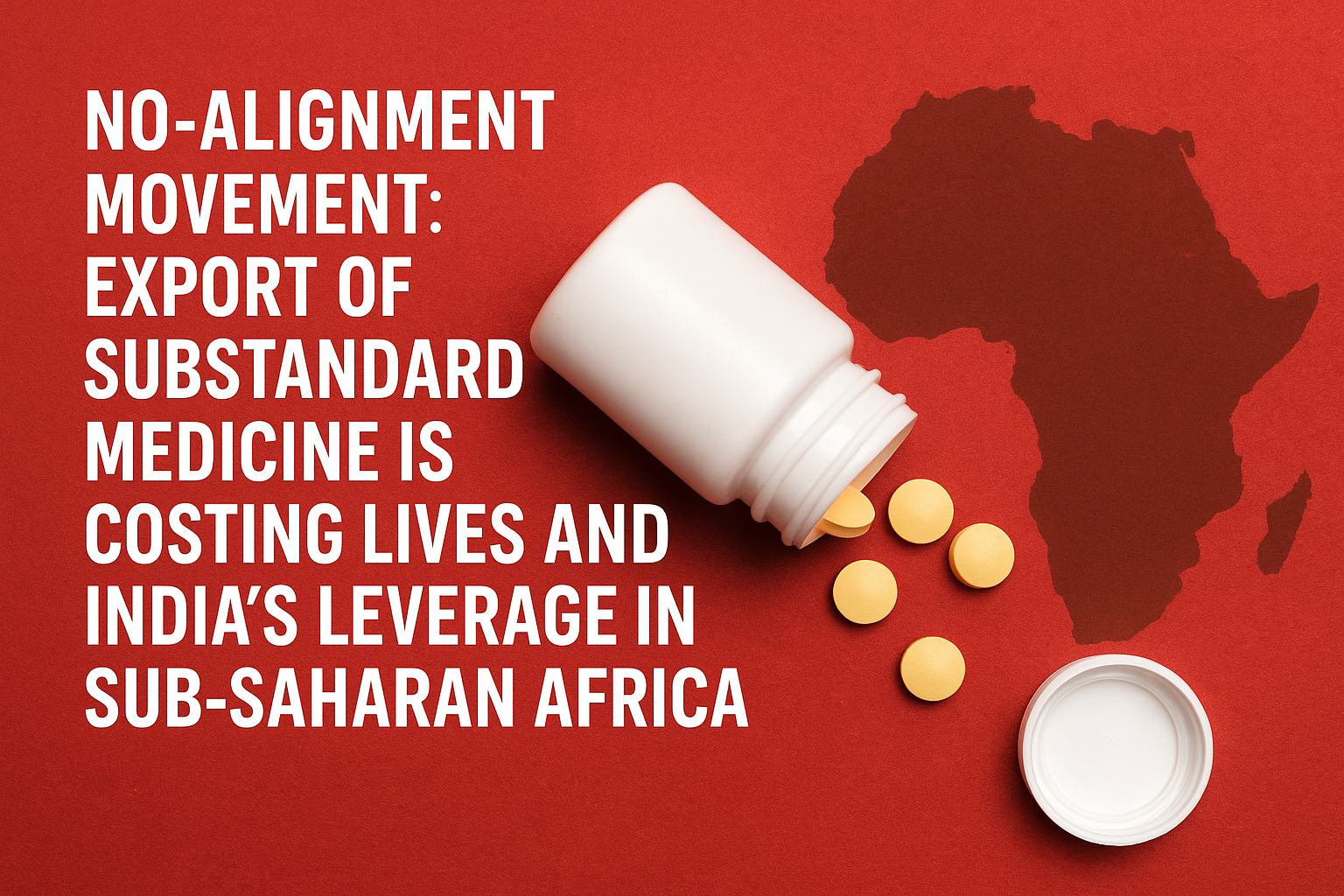

In September 2022, 70 children died in what became a sordid scandal in Savannah. But their lives were not lost to war, hunger or poverty — even as instability and violence gripped the Sub-Saharan region. Hundreds of families were instead unsuspecting victims of something they trusted the well-being of their children with — Medicine.
Having been rejected in testing at least five times in three states, being the subject of a national inquiry in 2018, and banned from conducting business in Vietnam, the manufacturer was only investigated and its factory closed by Indian authorities in 2023 as both countries involved passed the buck to one another for their lack of regulatory frameworks and poor implementation of the same — while the affected families were left stranded seeking justice. [1]
India — Pharmacy of the World
For decades, India has held the title of “pharmacy of the world” due to its ability to manufacture inexpensive versions of medicines, supporting the cause of universal healthcare — even in conflict-ridden, underdeveloped areas such as Sub-Saharan Africa, which rely heavily on medicines imported from India. Many of these medicines are life-saving drugs and vaccines that are distributed in areas affected by war and civil strife, as most people do not have access to proper healthcare services.
India also bravely supports reform in both the World Health Organisation and the World Trade Organisation to allow for greater representation of Least Developed Nations (LDCs) in technical decision-making, while resisting global pressure to restrict production of life-saving generics. However, the lack of updated statutes and guidelines has allowed local manufacturers to mass-export substandard and spurious medicines to the Sub-Saharan region. [2]
The Rod of Asclepius
There is a common misconception in medicine where people often mistake the Staff of Caduceus — twin serpents associated with business and thievery — for the Rod of Asclepius, a serpent symbol associated with healing and regeneration used by hospitals and clinics around the world.
This misconception applies to Indian pharmaceuticals — a strain resistant to strong regulations, proper manufacturing inspections, and the implementation of guidelines — which has often traded the Rod of Asclepius for the Staff of Caduceus at home and abroad. Leveraging developing countries’ heavy dependence on inexpensive generic medicine, India has built an empire of USD 25 billion in exports, with at least 12% of all generic medicines imported into Africa coming from Indian manufacturers. [3]
African Sub-Saharan countries have attempted to counter such substandard drugs. Gambia, along with six other countries, created the ‘Lomé Initiative’ to criminalise trafficking of falsified and substandard medicines with substantial penalties. The African Union (AU) also instituted the African Medical Agency (AMA) to combat regulatory deficits. However, such policies often do not reach conflict-ridden rural areas where medicine hawking and illegal trade remain rampant. Another worrying factor is how conflicts benefit corporations by disturbing regulations and supply chains — creating greater dependency on cheaper, substandard, or falsified medicines. [4]
India shoulders the moral responsibility of ensuring that manufacturers exporting drugs are regularly inspected and regulations adhered to. One cannot take pride in supplying affordable medicines to the world while avoiding accountability for preventable deaths caused by substandard and unregulated drugs — which have severely harmed India’s soft power in the region. Despite warnings from the WHO and US FDA, one must remember that India’s pharmaceutical journey began with noble intent through the Patents Act of 1970, which enabled the mission of universal healthcare. [5]
Tryst with Destiny
Before the 1970s, India relied heavily on imported medicines, a trend exploited by Western companies that hiked prices and monopolised markets. The Patents Act of 1970 granted local manufacturers the right to reverse-engineer expensive drugs, causing the domestic market to surge. This enabled the production of cheaper life-saving medicines for local use and export, especially to Africa.
A major example is Cipla’s role in HIV/AIDS treatment. Concerned by the epidemic in Africa, the company reduced the cost of essential medicines significantly, lessening dependence on unaffordable Western drugs. [6]
Combined with the Commonwealth, the Non-Aligned Movement (NAM), and the spread of WHO-certified Indian pharmaceuticals, India gained immense soft power. It provided not just medicine but hope, stability, and training to rural and conflict-affected areas in Africa. [7]
In numbers, Cipla’s Antiretroviral (ARV) drugs reduced the cost of HIV treatment by 75%, helping reduce HIV prevalence in Sub-Saharan Africa from 5.1% to 4% (2001–2017). Another milestone was the eradication of meningitis in the Meningitis Belt, thanks to the Serum Institute of India’s MenAfriVac priced at just 50 cents. [8]
Eroding Trust and Cause for Pessimism
Zapffe’s Irish Elk — a magnificent creature burdened by its ever-growing horns — is an apt metaphor for Indian pharmaceuticals. Once symbols of India’s soft power, they are now associated with at least 500,000 preventable deaths annually in Sub-Saharan Africa due to the influx of substandard and falsified medicines. [9]
Frequent scandals, country-wide bans, and seizures of spurious medicines have severely weakened India’s reputation, even as China rises rapidly. China has expanded its pharmaceutical influence by building local drug manufacturing capacity in Africa — a major advantage over India. One example is Sansheng Pharmaceuticals’ initiative to reduce Ethiopia’s dependence on imports by producing medicines locally. [10]
The post-pandemic African pharmaceutical sector is now a battleground. While India remains ahead in sheer numbers, China’s growing influence has trimmed India’s leverage. As spurious drug-related crises continue to accumulate, India risks losing its long-held advantage in the Sub-Saharan region — a bitter pill for its health diplomacy to swallow.
Dhruv approaches his work with curiosity, analytical rigour, and humility, striving to support transparent and inclusive policymaking. He remains committed to continuous learning and making meaningful contributions to the policy and governance space. Guided by the phrase Dum Spiro Spero..