
Issue Brief:
Critical Moments as Flotilla Enters High-Risk Zone
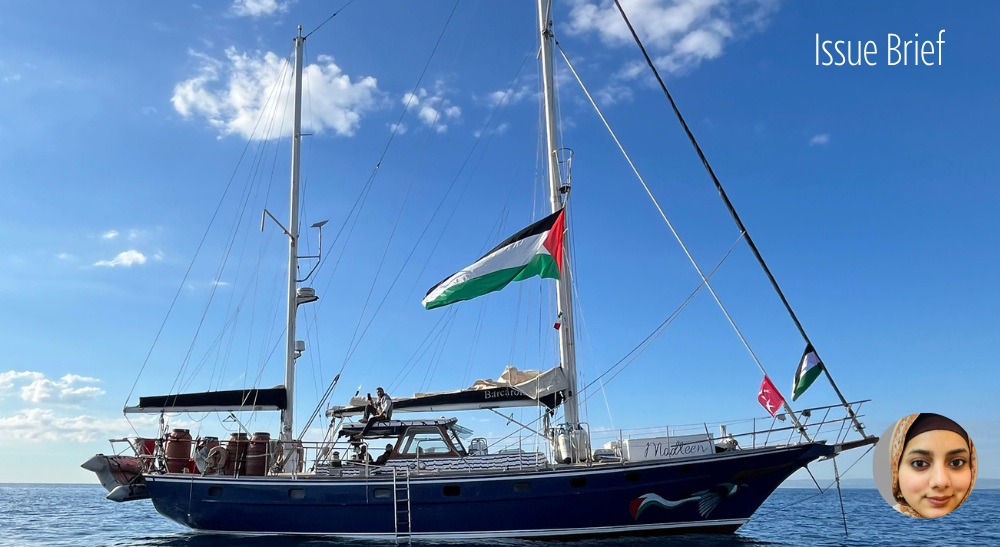
The Global Sumud Flotilla, the largest civilian-led maritime mission to Gaza in history, has reached a pivotal moment as it enters Israeli interception waters less than 200 nautical miles from the besieged Palestinian territory. As of the evening of September 30, 2025, activists aboard more than 40 vessels are bracing for what they expect to be an imminent Israeli military interception, with many predicting it could occur within hours.
The flotilla has officially entered what organizers term the “danger zone” or “orange zone”—the area where previous aid missions, including the Madleen and Handala vessels, were intercepted by Israeli forces earlier in 2025. Italian activist Yassine Lafram, president of the Union of Islamic Communities of Italy, stated from aboard the Karma vessel: “We are about 200 miles from the Gaza Strip, so two or three days of sailing. We are in the middle of international waters between Greece and Turkey. Most likely, tonight or tomorrow, we will be intercepted by the Israeli army”.
Mission Overview and International Scope
The Global Sumud Flotilla represents an unprecedented coalition of international solidarity with Palestine, bringing together over 50 vessels with more than 500 participants from 44 countries. The mission emerged in July 2025 through the consolidation of multiple activist movements: the Freedom Flotilla Coalition, Global Movement to Gaza, Maghreb Sumud Flotilla, and Sumud Nusantara.
Named after the Arabic word “sumud” meaning steadfastness or resilience, the flotilla carries humanitarian supplies including food, medicine, and baby formula to Gaza’s 2.4 million Palestinians who have endured an 18-year Israeli blockade. The mission aims not only to deliver aid but to establish a permanent humanitarian corridor and “break the siege” imposed on Gaza.
Notable Participants and International Support
The flotilla includes prominent figures such as Swedish climate activist Greta Thunberg, who previously attempted to reach Gaza in June 2025 before being intercepted and detained by Israeli forces. Other notable participants include Zwelivelile Mandela (Nelson Mandela’s grandson), Italian parliamentarians, European MPs, lawyers, doctors, and activists from across the globe.
The steering committee features activists including Thiago Ávila, Yasemin Acar, Kleoniki Alexopoulou, and Saif Abukeshek, with public support from figures like UN Special Rapporteur Francesca Albanese, actor Mark Ruffalo, and musician Roger Waters.
Escalating Tensions and Military Preparations
Israeli authorities have declared their intention to prevent the flotilla from reaching Gaza “under any circumstances”. The Israeli Navy has been conducting extensive preparations, with military officials stating they are ready to intercept the vessels despite acknowledging this mission presents unprecedented challenges due to its scale.
IDF spokesman Brig. Gen. Effie Defrin noted: “This one is different, with dozens of vessels,” highlighting the complexity of intercepting such a large fleet. Israeli plans involve transferring activists to large warships and towing vessels to Ashdod Port, with military sources suggesting some boats may be sunk during the operation.
Drone Attacks and Sabotage
The flotilla has faced multiple attacks during its journey, with organizers documenting at least three separate drone incidents:
1) September 8-9, 2025: Two attacks on vessels docked at Sidi Bou Said port in Tunisia, with the British-flagged Alma vessel reportedly struck by an incendiary device that started a fire.
2) September 23-24, 2025: Sustained drone attacks in international waters off Greece, involving at least 13 explosions and widespread communication disruptions affecting multiple vessels.
Activists reported that drones dropped “unknown objects” and “flashbang” devices on at least ten vessels, causing damage but no casualties. The flotilla has accused Israel of conducting these attacks, though Israeli authorities have not officially responded to these allegations.
International Naval Escort and Diplomatic Tensions
European Naval Deployment: In response to the drone attacks, Spain and Italy deployed naval vessels to escort the flotilla, with both governments emphasizing they would provide protection but not engage militarily with Israeli forces. Turkey has also joined the monitoring effort, with flight data showing Turkish drones from Corlu airbase circling the flotilla for three consecutive days.
However, as the flotilla approaches the critical 150 nautical mile threshold from Gaza, Italy announced its navy will cease escort duties. Italian Defense Minister Guido Crosetto stated the Italian frigate would issue final warnings around midnight GMT on September 30, before withdrawing to avoid “a diplomatic incident” with Israel.
Cyprus Compromise Rejected: Both Italy and Israel proposed a compromise whereby the flotilla would deliver aid to Cyprus for subsequent distribution by the Catholic Church’s Latin Patriarchate of Jerusalem. Flotilla organizers have repeatedly rejected this proposal, with participants insisting on their right to deliver aid directly to Gaza and challenge the blockade.
UN and International Legal Support: The mission has received backing from United Nations experts, who on September 8, 2025, urged Israel to “cease all threats of harm against the Global Sumud Flotilla” and ensure safe passage for the humanitarian mission. The UN experts characterized any attempt to block the flotilla as “a grave violation of international law and humanitarian principles”.
Amnesty International has also called for protection of the flotilla as it approaches Gaza’s shores, expressing concern over Israeli threats. Croatian lawyer Morana Miljanovic, aboard one of the vessels, warned that any Israeli interception efforts would be “clearly illegal”.
Gaza’s Humanitarian Crisis and Blockade Context
The flotilla’s mission occurs against the backdrop of Gaza’s devastating humanitarian situation, with over 66,000 Palestinians killed since October 2023, according to local health authorities. Israel has maintained its blockade of Gaza since Hamas took control in 2007, citing security concerns and the need to prevent weapons smuggling.
The UN has confirmed famine conditions in Gaza, with the organization’s humanitarian chief attributing the crisis to Israel’s “systematic obstruction” of aid access. Despite Israeli claims of facilitating aid delivery, the flotilla participants argue that the blockade constitutes collective punishment and violates international law.
Israeli Allegations and Counter-Narratives
Hamas Connection Claims: On September 30, 2025, Israeli authorities escalated their rhetoric by claiming to have discovered documents in Gaza showing “direct involvement” between flotilla leaders and Hamas’s overseas arm, the Palestinian Conference for Palestinians Abroad (PCPA). Israel designated PCPA as a terrorist organization in 2021, describing it as Hamas’s “representative body abroad”.
Israeli National Security Minister Itamar Ben-Gvir has proposed treating flotilla participants as terrorists and imprisoning them in Ketziot and Damon prisons. The Global Sumud Flotilla responded by denouncing these statements as “intimidation” and “a blatant violation of international humanitarian law”.
Activists’ Response: Flotilla participants have categorically rejected Israeli allegations, emphasizing the purely humanitarian and nonviolent nature of their mission. Greta Thunberg dismissed Israeli claims that the mission constitutes a “publicity stunt,” stating: “I don’t think anyone would risk their life for a publicity stunt”.
Italian MP Arturo Scotto, aboard the Karma vessel, noted the diverse composition of flotilla participants, including “secular citizens and Catholics, young and old, workers and entrepreneurs” united by humanitarian concerns.
Current Status and Imminent Confrontation
As of 23:33 on September 30, 2025, the Global Sumud Flotilla continues its approach toward Gaza despite mounting pressure and threats. Key vessels Jeannot III and Estrella are leading the convoy, with activists maintaining 24/7 live streaming as a security precaution.
Malaysian organizers from the Sumud Nusantara Command Centre report that all vessels entered the “second-level yellow zone” at 3 PM on September 30, with an expected entry into the “red zone” around 7 PM the following day. The flotilla currently maintains a speed of 4.9 knots with favorable weather conditions.
Legal Framework and International Law
The flotilla operates under the principle that Israel’s blockade of Gaza violates international law, citing the right of Palestinians to control their territorial waters and receive humanitarian assistance. Legal experts aboard the vessels have prepared to document any Israeli interception as a violation of international maritime law.
The mission represents a direct challenge to what participants view as an illegal siege that has prevented adequate humanitarian aid from reaching Gaza’s civilian population for nearly two decades. Organizers emphasize their commitment to nonviolent resistance while preparing for potential arrest and detention.
Historical Context and Previous Flotillas
The Global Sumud Flotilla builds on 15 years of maritime missions to Gaza, following in the tradition of previous attempts to break the blockade. Notable previous missions include:
1) 2010 Mavi Marmara: Israeli commandos killed 10 Turkish activists during the interception
2) 2025 Conscience: Attacked by drones 14 nautical miles off Malta in May
3) 2025 Madleen: Intercepted 100 nautical miles from Gaza in June
4) 2025 Handala: Intercepted 70 nautical miles from Gaza in July
The current mission represents the largest coordinated civilian effort to challenge the blockade, with organizers hoping the scale and international attention will provide some protection against violent interception.
Key Takeaways: A Test of International Will
The Global Sumud Flotilla stands at a critical juncture as it approaches the most dangerous phase of its mission. With Israeli forces prepared for interception and international naval escorts withdrawing, the coming hours will test both the resolve of the activists and the international community’s commitment to humanitarian principles.
The mission has already succeeded in drawing unprecedented global attention to Gaza’s plight and challenging the international community’s failure to ensure safe humanitarian access to the besieged territory. Whether the flotilla reaches Gaza or faces interception, it has established itself as the most significant civilian challenge to Israel’s blockade in the mission’s 18-year history.
As flotilla spokeswoman Maria Elena Delia stated in her final video message: “Israel will probably attack us tonight, because all the signals point to this happening”. The world now watches as this historic mission enters its most perilous phase, with the activists’ safety and the broader question of humanitarian access to Gaza hanging in the balance.
About the Author

Wasia Khan is a graduate in Turkish Language and Literature from Jamia Millia Islamia, and holds a Master’s in International Relations from the MMAJ Academy of International Studies of the same university. She is Deputy Executive Director of CDFA Research Foundation, and currently serves as the Director of the Division of Strategic & International Affairs.
Disclaimer: The opinions expressed in this article are solely those of the authors and do not necessarily reflect the views of CDFA or any affiliated organisation.