
Article:
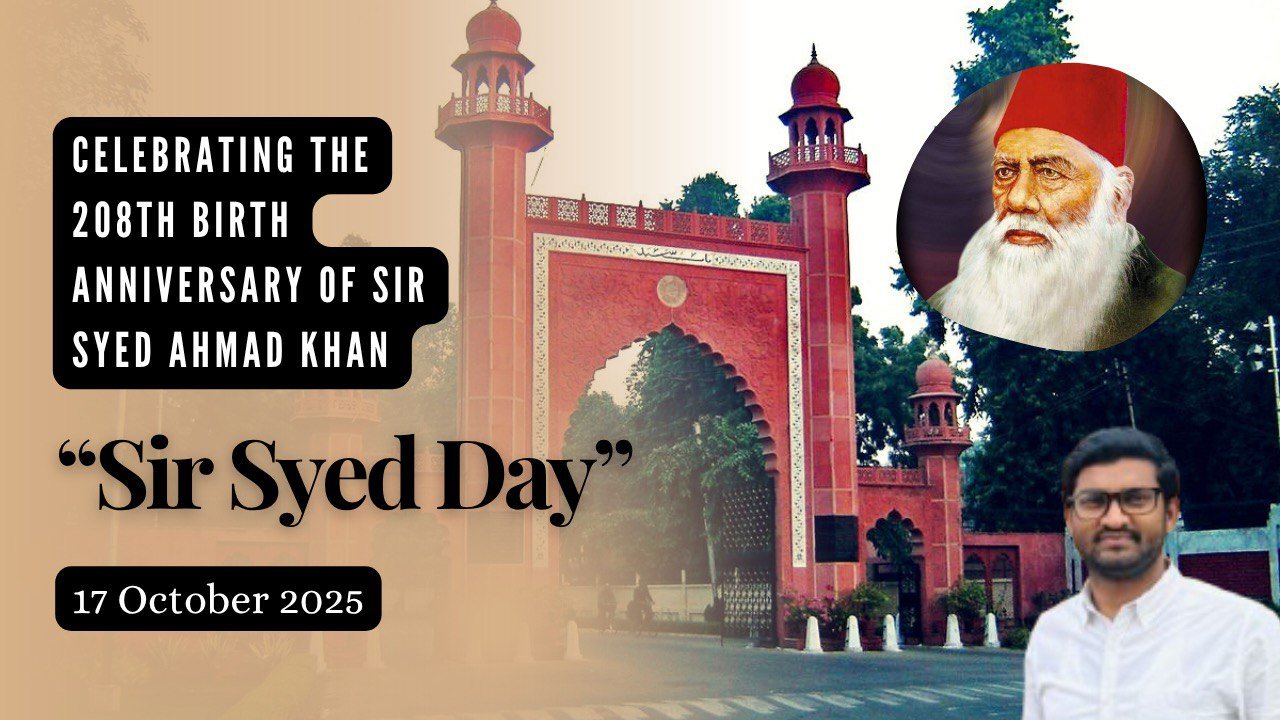
Celebrating the 208th Birth Anniversary of Sir Syed Ahmad Khan — Sir Syed Day, 17 October 2025
This year, on 17 October 2025, Aligarh Muslim University (AMU) and institutions across India commemorate the 208th birth anniversary of Sir Syed Ahmad Khan (1817–1898), widely celebrated as Sir Syed Day. Born in Delhi during the twilight of the Mughal Empire, Sir Syed lived through one of the most tumultuous periods in Indian history, witnessing the decline of traditional Muslim authority and the rise of British colonial dominance. His life and work reflect a unique blend of historical insight, rational thought, and educational vision, which enabled him to guide the Muslim community through social and intellectual challenges.
Sir Syed Ahmad Khan was not only a pioneering educationist but also a reformer, thinker, and historian. He recognized that the future of Indian Muslims depended on embracing modern knowledge while retaining ethical and religious values. Through his writings, lectures, and institutions, he encouraged the adoption of scientific reasoning, rational discourse, and practical skills, emphasizing that progress and tradition could coexist harmoniously. His efforts laid the groundwork for what later became known as the Aligarh Movement, which cultivated a generation of socially responsible, intellectually capable, and globally aware Muslims.
Across the AMU campus, students actively participate in debates, quizzes, essay competitions, recitations, and cultural performances, reflecting Sir Syed’s rationalist philosophy and commitment to social reform. Skits, plays, and dramatizations of his life inspire pride, intellectual curiosity, and moral purpose among the student community. The university is adorned with banners, portraits, exhibitions, and book displays, highlighting Sir Syed’s writings, publications, and achievements. Students also organize community service programs, literacy campaigns, and awareness drives, embodying his ideals of social upliftment, moral progress, and educational advancement.
Sir Syed Day thus evolves into a festival of knowledge, reflection, and cultural pride, bridging historical legacy with contemporary intellectual engagement and inspiring youth to uphold values of reason, ethics, and enlightenment.
Colonial Context and the Crisis of Muslim Identity
The Revolt of 1857 drastically altered the socio-political landscape of India. Indian Muslims, who had historically played a dominant role in administration, the military, and cultural life under the Mughals, suddenly found themselves politically disenfranchised and socially marginalized. The British authorities associated Muslims with rebellion, leading to widespread exclusion from civil services, government posts, and the emerging educational institutions that were rapidly gaining influence in colonial India.
The decline of traditional madrasas compounded the crisis. These centers of learning, once vibrant with religious, philosophical, and rational instruction, struggled to compete with Western-style schools promoted under colonial rule. As a result, an entire generation of Muslims lacked exposure to modern sciences, the English language, and administrative skills, all of which were increasingly necessary for social mobility and economic participation.
Sir Syed Ahmad Khan meticulously analyzed this crisis in his pamphlet The Causes of the Indian Revolt (1858). He argued that the rebellion was not a failure of Islamic faith but a consequence of miscommunication, administrative incompetence, and educational stagnation. Observing the new political realities, he urged Muslims to adopt pragmatic loyalty to the British, not as submission, but as a strategic choice to regain access to opportunities, education, and employment.
In addition to political considerations, Sir Syed emphasized the cultural and intellectual dimensions of the crisis. He recognized that without engagement with modern knowledge, the community would remain isolated and unable to compete in a rapidly changing world. He advocated for the study of Western sciences, modern philosophy, and administrative techniques while maintaining Islamic ethics and values. By promoting a rational understanding of religion alongside contemporary education, Sir Syed sought to create a community capable of self-improvement, resilience, and meaningful participation in society. His approach combined pragmatism, foresight, and reformist vision, laying the foundation for the Aligarh Movement and for a Muslim society capable of navigating the complex challenges of colonial India.
Rationalism, Enlightenment Influence, and Religious Reform
Sir Syed Ahmad Khan’s intellectual evolution was profoundly shaped by exposure to Western philosophy, science, and literature. He studied the works of thinkers such as Francis Bacon, John Stuart Mill, and Voltaire, which inspired him to embrace empirical reasoning, critical inquiry, and pragmatic problem-solving. This rationalist outlook became the foundation of his reformist vision for Muslim society, emphasizing that knowledge, reason, and ethical responsibility were essential for progress.
In the religious sphere, Sir Syed sought to reconcile faith with reason. Through his Tafsir-ul-Quran, he highlighted the moral, ethical, and allegorical dimensions of the Quran, encouraging Muslims to interpret scripture in the light of contemporary knowledge and scientific understanding. His assertion that “The Word of God cannot contradict the Work of God” reflected his conviction that divine revelation and the laws of nature were not in conflict but in harmony. He believed that understanding natural laws and embracing modern sciences could strengthen faith rather than weaken it.
This rationalist approach drew criticism from orthodox scholars, who often viewed his methods as unorthodox. Nevertheless, Sir Syed remained steadfast, advocating ijtihad (independent reasoning) as a responsible method for interpreting religious laws and adapting them to contemporary realities. He promoted scientific observation, critical thinking, and open discourse, laying the groundwork for Muslim modernism. His vision encouraged engagement with global ideas while maintaining spiritual and moral integrity, fostering a community capable of intellectual growth, social responsibility, and ethical conduct.
Beyond theology, Sir Syed’s rationalist philosophy influenced education, social reform, and political thought. He emphasized that Muslims must acquire practical knowledge and skills to participate effectively in the changing socio-political landscape of colonial India. By blending rational inquiry with ethical and religious principles, he created a framework that guided the intellectual revival of Indian Muslims. His efforts inspired broader debates on modernity, education, and ethics across the Muslim world, cultivating a generation of progressive thinkers, reformers, and leaders committed to social advancement and intellectual engagement.
Through this synthesis of religion and reason, Sir Syed not only contributed to an enlightened approach to Islam but also demonstrated that faith and modern knowledge could coexist harmoniously, creating a resilient and forward-looking Muslim society.
Educational Reform and the Aligarh Movement
Recognizing education as the key to empowerment, Sir Syed Ahmad Khan founded the Muhammadan Anglo-Oriental College (MAO College) in 1875, which later evolved into Aligarh Muslim University (AMU). His vision was to cultivate a modern Muslim elite proficient in Western sciences, mathematics, English language, and administrative skills, while maintaining a strong foundation in Islamic ethics, literature, and culture. He believed that education should empower individuals not only intellectually but also morally and socially, preparing them to contribute meaningfully to society.
“A true Muslim is one who must hold the Holy Quran in one hand and science in the other.” – Sir Syed Ahmad Khan
Beyond academics, the institution emphasized discipline, character development, and cultural refinement, producing graduates capable of navigating colonial bureaucracy and actively participating in social reform and nation-building. Sir Syed’s approach demonstrated that modern education and cultural rootedness were not contradictory but complementary, enabling students to embrace progress without losing their ethical and spiritual identity.
Through his journal Tahzib-ul-Akhlaq, Sir Syed propagated moral, social, and educational reform, addressing issues such as women’s education, public health, rational thinking, and ethical conduct. The Aligarh Movement extended beyond the college, establishing a network of schools, study circles, and discussion forums that nurtured intellectual curiosity, civic responsibility, and critical engagement with contemporary issues. It created a vibrant community dedicated to both academic excellence and social betterment.
Sir Syed’s educational framework not only equipped students with the skills necessary for colonial administration but also instilled confidence, analytical thinking, and cultural awareness. By promoting education as a tool for personal growth and societal advancement, he transformed Indian Muslim society, enabling it to respond effectively to the challenges of modernity, colonial rule, and social change. The Aligarh Movement thus became a cornerstone of intellectual revival, producing generations of enlightened thinkers, reformers, and leaders who carried forward Sir Syed’s vision of progress and empowerment.
Social Reform and Cultural Modernization
Sir Syed Ahmad Khan believed that social progress was inseparable from education. He challenged rigid adherence to outdated customs and emphasized the need for rational evaluation of societal norms. His efforts focused on promoting literacy, ethical conduct, and social responsibility, encouraging Muslims to think critically about cultural practices and adopt reforms that strengthened the community without compromising its identity.
He was among the earliest reformers to advocate women’s education, initially through basic literacy and domestic sciences, emphasizing its significance for both family welfare and societal development. By promoting ijtihad, or independent reasoning, Sir Syed empowered Muslims to reinterpret religious practices in ways that addressed contemporary challenges, fostering a culture of informed and rational religious practice.
Through his writings, lectures, and public addresses, he urged the community to engage deeply with history, science, and literature, cultivating intellectual curiosity, critical thinking, and moral integrity. He believed that cultural modernization did not mean blind imitation of Western practices but rather the enhancement of rational thought, ethical awareness, and social cohesion, enabling the community to progress while remaining rooted in its spiritual and moral values. Sir Syed also emphasized civic responsibility, ethical leadership, and the importance of public engagement. By integrating educational reform, social awareness, and cultural ethics, he laid the foundation for a progressive Muslim society capable of embracing modernity, participating effectively in public life, and preserving its moral and spiritual essence. His vision created a template for social reform that inspired subsequent generations to combine tradition with rational inquiry, ensuring that modernization was both thoughtful and culturally grounded.
Sir Syed Ahmad Khan and His Historical Scholarship
Sir Syed Ahmad Khan was not only a pioneering educationist and social reformer but also a dedicated historian and cultural scholar. He possessed a profound interest in India’s rich historical and architectural heritage and believed that understanding the past was essential for intellectual growth, social progress, and the cultivation of a rational and enlightened society.
His historical writings are extensive and cover a wide range of topics. Early in his career, he authored Jam-e-Jam (1839), chronicling the dynasties of Delhi from Timur to Bahadur Shah Zafar. Following the Revolt of 1857, he carefully examined its causes in Asbab-i -Baghawat-i-Hind, attributing the uprising to administrative failures, social disintegration, and miscommunication rather than solely religious reasons. He also revised and edited Abul Fazal’s Ain-i-Akbari, studied Barani’s Tarikh-i- Firozshahi, and Jahangir’s Tuzuk-i-Jahangiri, demonstrating a meticulous and scholarly approach to historical documentation and critical analysis.
Sir Syed’s Asar-us-Sanadid stands out as a monumental work in archaeology, offering detailed descriptions of Delhi’s monuments, including their architectural features, construction history, repairs, and patrons. His attention to detail and commitment to accuracy earned international recognition, including translation into French and an honorary fellowship from the Asiatic Society, London. Beyond texts, he collected and preserved sculptures, carved stones, and architectural panels, reflecting his dedication to conserving India’s tangible cultural heritage.
Through his historical scholarship, Sir Syed illustrated how knowledge of the past could guide social and intellectual reform, providing context for educational initiatives and cultural revival. He emphasized that understanding history was not merely academic but a practical tool for community empowerment, moral guidance, and strategic engagement with contemporary challenges. By linking historical analysis with social reform, Sir Syed set a model for modern scholarship that combined rigorous research, ethical responsibility, and cultural preservation, inspiring generations of historians, educators, and reformers.
Legacy and Modern Relevance
Sir Syed Ahmad Khan’s influence extends far beyond education, encompassing social, cultural, and political spheres. The graduates of Aligarh Muslim University became teachers, administrators, journalists, and reformers, carrying forward his vision of a rational, enlightened, and socially responsible community. His emphasis on scientific learning, critical thinking, and moral integrity helped reshape Muslim society’s response to modern challenges, enabling it to engage with global ideas while preserving cultural identity and ethical values.
Sir Syed’s works continue to inspire curricular reforms, literary criticism, and socio-cultural debates. His approach of combining historical analysis, rational inquiry, and moral reflection set a benchmark for modern education and intellectual discourse. Contemporary educational institutions and policymakers frequently invoke his principles to foster critical thinking, ethical leadership, and community development, demonstrating the enduring relevance of his vision.
Beyond education, Sir Syed championed social cohesion, intercultural understanding, and civic responsibility. He promoted a balanced worldview, advocating engagement with science, governance, and modern knowledge while retaining spiritual and ethical roots. By encouraging Muslims to adopt reasoned pragmatism alongside moral and religious principles, he created a framework for personal growth, societal progress, and resilient community development.
His legacy also emphasizes the role of education in empowering marginalized communities and creating socially responsible citizens. Sir Syed demonstrated that progress is achievable through knowledge, rational thought, and moral courage, offering a model that remains profoundly relevant today. Across India and the broader Muslim world, his vision continues to guide educators, reformers, and thinkers, inspiring generations to embrace learning, ethical leadership, and enlightened social engagement.
Conclusion
Sir Syed Ahmad Khan’s life and work exemplify the delicate balance between tradition and modernity, faith and reason, loyalty and self-assertion. Through education, rationalism, and social reform, he transformed the intellectual and cultural landscape of Indian Muslims, preparing them to navigate the complex challenges of colonial and post-colonial society. His efforts demonstrated that progress is not merely the adoption of new knowledge, but the harmonious integration of tradition, ethics, and modernity.
The Aligarh Movement, one of his most enduring reforms, created a modern Muslim intelligentsia capable of engaging with global knowledge systems, participating effectively in administration, and contributing to social and cultural advancement. Sir Syed’s insistence on rational inquiry, independent thought, and ethical responsibility empowered generations to view education not merely as personal advancement but as a tool for societal transformation. He emphasized that a community’s strength lies in its ability to adapt to changing circumstances while remaining grounded in its moral and spiritual principles.
Sir Syed’s philosophy also illustrated that religion and reason need not be in conflict. By advocating for strategic pragmatism in political engagement, he ensured that the Muslim community could safeguard its interests, acquire education and skills, and maintain its cultural identity without succumbing to symbolic or destructive resistance. His approach was visionary, prioritizing long-term empowerment, social resilience, and community welfare. In contemporary times, Sir Syed’s principles continue to guide educators, policymakers, and social reformers. His emphasis on knowledge, rationality, moral integrity, and ethical leadership remains profoundly relevant, demonstrating that true progress arises from the balanced fusion of intellect, culture, and ethics. Sir Syed Ahmad Khan, through his life, writings, and legacy, continues to illuminate the path of enlightened reform, inspiring communities to embrace education, reason, and moral courage as the foundation for sustainable social progress. His vision serves as a timeless reminder that modernization and cultural preservation can coexist, offering a blueprint for building thoughtful, resilient, and empowered societies.