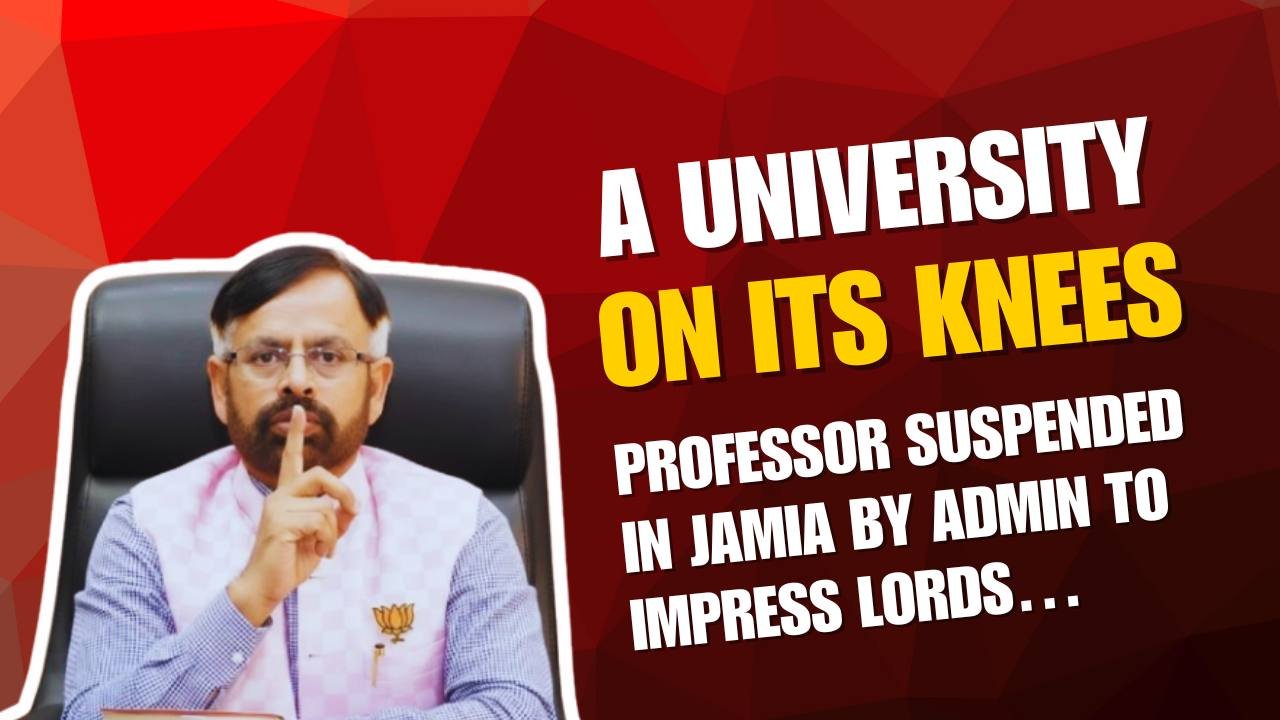

New Delhi: Jamia Millia Islamia University has placed a faculty member of its Department of Social Work under suspension following widespread complaints over the content of a recent semester question paper. According to official orders issued on December 23, the professor who set the first-semester examination paper for the BA (Honours) Social Work course has been suspended with immediate effect, and an inquiry committee has been constituted to investigate the matter. The question in dispute appeared in the “Social Problems in India” syllabus and asked students to:
“Discuss the atrocities against Muslim minorities in India, giving suitable examples?”
Within hours of the examination, images of the question paper circulated widely on social media, triggering intense reactions from various quarters. Several social media users and commentators described the question as “provocative” and “communal,” demanding immediate administrative action.
A notice attributed to the university’s Officiating Registrar, C. A. Sheikh Safiullah, stated that a police FIR would be registered “as per rules”, and that the professor would remain under suspension pending the outcome of the inquiry. The order also restricts the faculty member from leaving New Delhi without prior permission. However, at the time I am writing this, Jamia officials have not publicly clarified the precise objections to the academic content of the question, nor have they explained how the question violated existing academic norms or university regulations.
Who Is the Suspended Professor? The professor placed under suspension has been identified as Prof. Virendra Balaji Shahare, a faculty member of the Department of Social Work who set the examination paper. He has been directed to cooperate fully with the inquiry committee. According to available background information, Prof. Shahare has significant academic experience, including teaching and research in the social sciences. The university administration has stated that further action will depend on the findings of the inquiry.
Institutional and Public Response: The incident has sparked a wider debate on academic freedom, classroom autonomy, and the role of universities in addressing contemporary social realities. Several student groups, academics, and civil rights advocates have criticized the suspension as disproportionate and heavy-handed, raising concerns about shrinking spaces for critical engagement within universities. At the same time, some observers have supported the administration’s decision, arguing that greater caution should be exercised while framing examination questions on sensitive communal issues. Beyond the suspension order and inquiry notice, Jamia Millia Islamia has not issued any detailed public statement elaborating its position.
Jamia Millia Islamia was not built to bow. It was born in resistance, nurtured in sacrifice, and shaped by the belief that education must stand taller than power. And yet, today, Jamia stands with its head lowered, not by force, but by choice. The suspension of a professor from the Department of Social Work is not merely an administrative action. It is a moral collapse. A university that once resonated with debates on justice, equity, and dissent has now chosen the language of files, notices, and fear. A teacher, whose duty is to question, critique, and awaken conscience, has been punished not for misconduct, but for engaging with a subject that lies at the very heart of social science inquiry.
This is not discipline.
This is intimidation.
The Administration is now an extension of power, the Jamia administration today appears less like the custodian of an academic institution and more like an obedient extension of the ruling establishment. Every suspension order, every show cause notice, every silencing of a critical voice appears like a carefully choreographed act—meant not for the university community, but for authorities beyond its walls.
“It reeks of an anxiety to impress political masters.”
Instead of shielding faculty from external pressure, the administration has chosen compliance. Instead of defending academic autonomy, it has offered submission. Instead of standing with its teachers, it has pushed them into isolation.
“History will remember this moment, not for what the professor asked, but for what the institution failed to defend.”
This is also a blow to Social Work, a discipline rooted in justice: That this action originates from the Department of Social Work makes the wound deeper. Social work is not a neutral discipline. It is grounded in empathy, resistance to injustice, and solidarity with the marginalized. Suspending a social work professor for critically engaging with social realities is akin to punishing a doctor for treating the wounded or a journalist for reporting inconvenient truths.
What message does this send to students?
That justice is acceptable only in textbooks.
That dissent is welcome only in seminars, not in practice. That courage will be met with punishment.
This is how institutions decay—not suddenly, but silently.
Jamia has witnessed police boots on its campus, students bleeding inside its libraries, and classrooms converted into spaces of surveillance and interrogation. Through these trials, the university survived because teachers and students stood together. Today, that bond is being dismantled from within.
An administration that penalizes its own faculty for critical academic engagement teaches students one lesson above all: fear works. And when fear becomes institutional policy, universities cease to be spaces of learning and turn into factories of obedience.
Institutions do not earn respect by pleasing power. They earn it by resisting injustice, even when resistance is costly.
Jamia was once that institution. It can still be, if it chooses courage over convenience, dignity over fear, and truth over submission.
Until then, this suspension will remain not merely an action against one professor, but a stain on the conscience of a university that momentarily forgot why it existed.
A Fundamental Question on the Syllabus Itself: When I personally went through the BA Social Work syllabus of Jamia Millia Islamia, it became abundantly clear that the controversial question was firmly rooted in the prescribed curriculum. In Unit II, Sub-Unit (c) of the paper Social Problems in India, the syllabus explicitly lists: “Atrocities against women, SC/STs, and minorities.”
In this context, it is difficult to comprehend how an examination question addressing atrocities against minorities, specifically Muslims, can be construed as an academic violation. If the paper setter is deemed wrong, then the entire syllabus drafting committee stands implicated. By extension, every academic body that approved the syllabus, every faculty member who teaches it, and indeed every member of the university who dares to challenge social evils becomes culpable.
To criminalize a question that faithfully reflects the syllabus is not corrective governance, it is institutional self-indictment.
Jamia must decide whether it wants to remain a university that confronts social injustice or one that retreats into silence at the first sign of pressure. The choice it makes today will define not just its academic future, but its moral legacy.