
Overview:
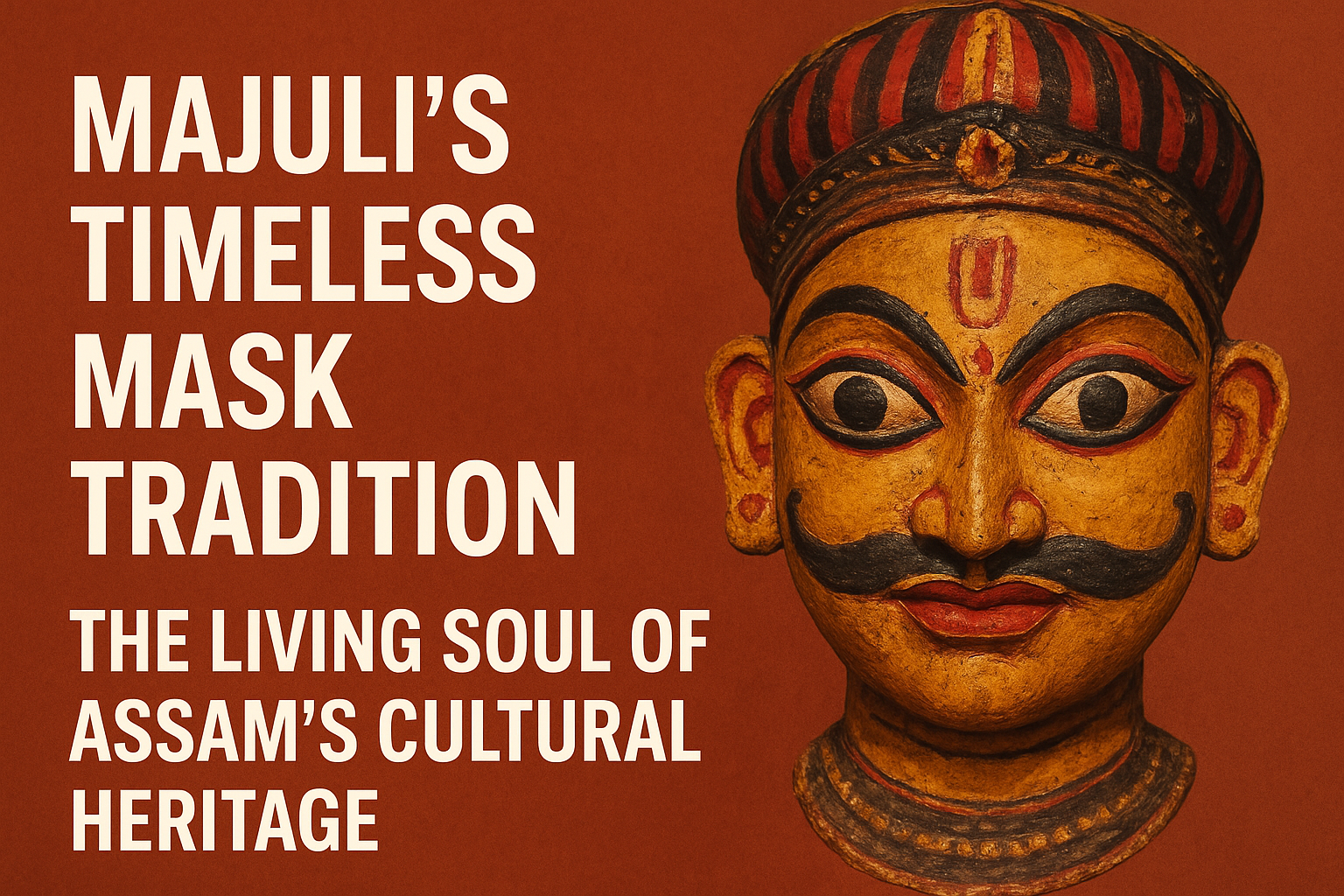
Indian culture is an enduring mosaic of harmony in diversity, where age-old customs and contemporary energy merge into a vibrant legacy. The five-hundred-year mask-making tradition of Assam is a unique specimen of the region’s culture and heritage. The earliest evidence of mask-making in India, as a documented cultural tradition, originates in Assam in the 15th century with Srimanta Sankardeva’s Bhaona performance.
Introduction
The traditional mask-making culture of Majuli stands as a deep and perpetual aspect of our intangible cultural heritage. Majuli, the world’s largest river island enfolded in the Brahmaputra River of Assam, is not only an ecological wonder but also a cultural home of Neo-Vaishnavism.
Neo-Vaishnavism was a movement spread by saint Sankaradeva during the fifteenth and sixteenth centuries. These vibrant masks are not merely works of art; they are an integral part of Majuli’s traditions, festivals, fairs, rituals, and Raas Leela. Sri Sri Samaguri Satra of Majuli (Assam) is a major centre of mask-making.
Historical Background
Making Majuli masks or mukha, dating back to the 15th and 16th centuries in Assam, was a popular aspect of the Bhakti movement—also called Neo-Vaishnavism—led by Shrimanta Sankardeva, who is regarded as the first khanikar or mask maker.
Theatrical traditions in Assam are distinguished by their use of masks, elaborate dance movements, and rich musical compositions, offering audiences a distinctive and engaging experience. This enduring art form preserves a deep connection to the region’s heritage while continuing to evolve.
Bordhuvan village in the Nagaon district of Assam is considered the birthplace of the craft of mask-making (popularly known as mukha) and is also the birthplace of social reformer Sankardeva, who introduced masks in his plays.
Guru Sankardeva utilised Majuli masks for the first time in his drama Cihna Yatra in 1468. Masks of Hara, Garuda, and Brahma were created for this performance. The use of masks by the bhaoriya (actors) enhanced the performance, making it more dramatic and visually appealing.
Later, Majuli mask-making flourished in different parts of Upper Assam and has now become a prominent part of Indian heritage and culture, receiving a GI (Geographical Indication) tag for its unique cultural significance and craftsmanship.
Majuli rises like a living poem in the heart of the Brahmaputra—a land where nature and spirituality blend in serene harmony. Shaped by the divine vision of Srimanta Shankardeva, this sacred island breathes the essence of Neo-Vaishnavite faith and art. Through Bhaona and the soulful artistry of Mukha Shilpa, Majuli continues to weave a tale of tradition, beauty, and enduring cultural spirit.
Type of mask
Majuli masks are divided into three types:
1. Barmukha (Great Mask):
Crafted in two parts—torso and head—the artist wears both simultaneously. These masks are around 10–12 feet high, earning the name Barmukha. The elaborate craftsmanship enhances the visual experience of theatrical performances.
2. Lotokari Mukha (Hanging Mask):
These masks consist of separate torso and head pieces. Designed to remain flexible, they allow the performer greater mobility. Examples include Putana, Taraka, Maricha, Subahu, and many other mythological forms.
3. Mukh Mukha (Face Mask):
These cover only the performer’s face. Considered ornamental, they complement the performer’s attire and are often used in expressive roles.
Fabrication Method
Tools and materials used in mask-making are locally sourced—bamboo, clay, cloth, paper, cane, jute, cow dung, etc. Artisans use a local bamboo variety known as jatibanh. Natural dyes such as tree seeds, bark, leaves, bael sap, mustard-oil lamp ash, and indigo are used for colouring.
1. Base Structure:
The process begins with creating a bamboo framework. The bamboo is cut, shaped, and woven into a sturdy skeleton designed to reflect the character’s facial features and expressions.
2. Clay Application:
A mixture of clay and cow dung is applied to shape the mask and smooth the bamboo surface. The mask is sun-dried after each layer to ensure durability. Once dried, the mask is carved to create facial details such as eyes, nose, and mouth.
3. Papier-Mâché Laye:
A paste made of paper pulp and water is applied to the clay layer. This makes the mask lightweight and comfortable for performers during long Bhaona performances.
4. Painting and Detailing:
Masks are painted with natural colours. Artisans carefully create intricate details—from the curve of the eyebrows to the sharp expression of the eyes. Demon masks, for example, are given bold, dramatic features to reflect their fierce nature.
Current Status
Assamese mask-making is practiced in the Sattras of Majuli and in the districts of Jorhat and Sivasagar. Majuli mask-makers received a GI tag in 2024. Renowned artist Dr. Hemchandra Goswami, a Padma Shri awardee, hails from this lineage of artisans. The Satradhikar (head) of Samaguri Satra continues to guide and elevate this craft.
Significance
Within Neo-Vaishnavite traditions, masks are sacred tools of transformation. During Bhaona, the performer becomes the character itself, blurring the line between human and divine.
Drawing from sacred texts, this theatre form reinforces the ethical and spiritual framework of the community. Combining drama, devotion, comedy, and action, it builds shared cultural consciousness and social harmony.
Beyond aesthetics, mask-making supports rural livelihoods in Assam. The blend of artistic skill and functional value preserves cultural identity while contributing to community well-being.
Conclusion
Majuli is more than an island—it is the living heartbeat of Assam, where every ripple of the Brahmaputra carries whispers of art, faith, and timeless traditions. Its charm lies not only in scenic beauty but in the devotion of its people, who nurture ancient customs with pride.
The Sattras, Naamghars, Bhaonas, and Mukha Shilpa together weave a cultural tapestry that captivates every visitor. Yet, behind this serenity lies a plea for preservation—a need to safeguard a land and its people who fight nature’s fury and cultural neglect. Majuli’s protection is not merely a duty but an act of love for heritage and humanity that binds them together.
Her academic interests lie at the intersection of history, culture, and civilizational studies. In addition to her teaching career, Apparna has worked as a content writer and editor at a law firm, where she curated and developed material for a weekly current affairs magazine. Currently in the final year of her B.Ed. program, she is actively preparing to pursue a Ph.D. in History, aspiring to make a meaningful contribution to academia and public discourse through research and scholarship..