


Issue Brief


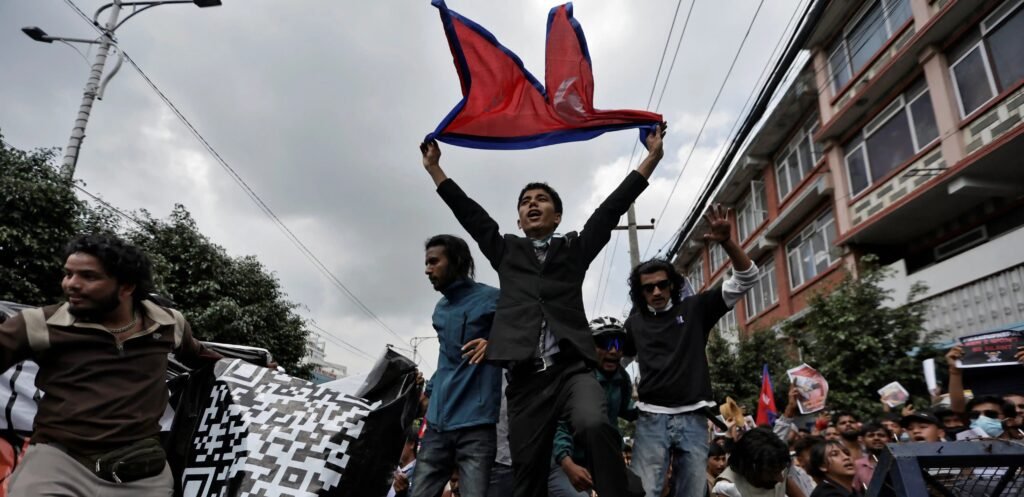
Nepal’s streets erupted in early September 2025 in a wave of youth-led protests that quickly became a national crisis. What began as mass opposition to a sweeping ban on 26 social platforms turned in a matter of days into deadly clashes with security forces, large-scale arson against political symbols including the federal parliament, mass resignations by politicians and ministers, the evacuation and temporary security control of critical sites by the army, and the resignation of Prime Minister K. P. Sharma Oli. The single immediate trigger was the social media ban, but that action lit a tinderbox made of long-running corruption, economic frustration among young people, the pattern of unstable coalition politics, and unresolved tensions from the republic transition. As the movement spread, other fault lines opened. Some groups pushed for a return to a Hindu state and even the monarchy, while rural and urban communities responded differently to the disruption. Questions immediately arose about external influences, including whether organised Hindu nationalist networks from India had a role in recent years in shaping social and political currents across the border. At the time of writing the country stands at a crossroads: its institutions face a credibility test, civil society and protesters demand accountability and reform, and neighbouring states must respond in ways that stabilise lives and commerce without appearing to interfere in Nepal’s sovereign politics. The events are consequential for India and the wider South Asia region because of deep economic links, shared borders, and the geopolitical competition that circles Kathmandu.
Key facts to hold in mind
- The immediate cause was the government directive that ordered a block or heavy restriction on 26 social platforms, seen widely as arbitrary censorship and a threat to young people’s livelihoods and political expression.
- Mass protests organized largely by digitally native youth cohorts unfolded across Kathmandu and many cities. The movement used alternative platforms to coordinate after the ban was announced.
- Security responses included tear gas, water cannon and reportedly live rounds; official tallies and external reports converged on about 19 dead and hundreds injured during the early days of confrontation.
- Protesters breached and set fire to the federal parliament building, attacked party offices and leading politicians’ houses, and forced evacuations that prompted the army to secure critical infrastructure including the international airport temporarily.
- The protests and ensuing political collapse have re-opened old debates about Nepal’s identity including calls by some groups for restoration of the Hindu state and even the monarchy. These currents pre-dated September but gained renewed visibility during the crisis.
Why this matters
Nepal’s turmoil matters for three overlapping reasons. First, it is a test of the republic’s institutions. Since the monarchy’s fall and the constitution of 2015, Kathmandu has struggled to build a stable, rights-protecting system that gives ordinary citizens confidence that grievances will be addressed without bloodshed. Second, Nepal’s location between India and China means domestic instability has external consequences. Cross-border trade, labour migration and diplomatic influence are all sensitive to sharp disruptions in Kathmandu. Third, the episode has regional symbolic power: the 2025 protests are part of a broader pattern in South Asia and beyond in which young people, organized online, can rapidly turn online outrage into street power. How Nepal handles this moment will shape politics and governance there for years to come
A short narrative of events
On September 4, 2025 the Ministry of Communications issued strict requirements and then moved to block or significantly restrict a long list of global social platforms on the grounds that they had failed to register or comply with new rules. The government framed the step as regulatory; for many citizens it looked like censorship designed to protect political elites from reputational harm. Within hours and certainly by the next day, young people across Kathmandu and other cities were calling for mass demonstrations. Digital networks such as TikTok, Telegram, and messaging apps that had not yet been blocked—were used to share meeting points, safety tips, and videos of police action. Over the weekend, crowds swelled outside the federal parliament and in major public squares. Security forces sought to keep the demonstrators back. Scenes escalated into lethal clashes on September 8 as police used crowd control measures; according to health ministry figures and multiple news outlets at least 19 people were killed and hundreds hurt. The following day protesters breached the parliament grounds and set parts of the building on fire. In response to threats to senior leaders and to public order the army assumed control of key sites, including the capital’s international airport, and helped evacuate targeted politicians. Under huge domestic and international pressure the prime minister resigned on September 9. Across the capital there were reports of cabinet members and party MPs tendering resignations, and at least one party saw a mass resignation of 21 of its members of parliament. Flights were diverted, borders saw higher security, and life in Kathmandu and many other cities was interrupted by curfews and internet disruptions.
Now questions arises how Gen Z led and how the movement organised itself?
The phrase Gen Z protests captures more than the age profile of protesters. It describes a particular mix of political language, organisation, culture and strategy. The cohort called Gen Z in Nepal comprises people who were born in the late 1990s and the 2000s. Many are the first in their families to use social platforms as a primary space for social life and for small business. For them the internet is not a hobby or luxury; it is a workplace, a marketplace and a public square. That is why the policy to ban platforms was experienced as an attack on both speech and livelihood.
Organisation and tactics
Unlike many past uprisings in Nepal that were channeled by political parties, labour unions or student unions, the 2025 uprising was largely decentralized and leaderless at first. Small groups coalesced on different apps and platforms, sharing short videos, memes and local meeting points. They used rapid, mobile tactics familiar from other youth movements globally: flash mobilizations, rotating meeting points to avoid predictable concentration, live streams to create real-time accountability, and creative cultural content that made participation feel like belonging. Protesters also used small economic incentives: collective donations to pay legal aid or medical bills and pooled rides for the most vulnerable participants. Several prominent young local personalities, such as popular mayors or social media figures, amplified calls to the street, but the wave began on the ground and online before party politicians could fully control it. Reuters and other outlets described activists using TikTok and Viber after the initial platforms were restricted in order to coordinate, showing the movement’s agility.
Motivations and messaging and Anecdotes from the ground
Protest rhetoric fused two core ideas. The first was demand for freedom of expression and opposition to abrupt censorship without consultation. The second was anti-corruption. Videos and posts that went viral just before the protests had highlighted luxury lifestyles linked to some political families, apparent unfairness in public procurement, and long-running stories of impunity. For many young people these were not separate grievances. The argument they made on the streets and online was simple and emotionally potent. If the state shields the powerful from public scrutiny and then tries to close the street that exposes them, it is acting in bad faith. That basic frame propelled the movement beyond the narrow question of digital regulation.
Media coverage and hundreds of user videos give a human feel to the political overview. One widely circulated clip showed a cabinet minister chased by demonstrators and forced into a river; images such as this became shorthand for the public’s humiliation of elites perceived to be out of touch. There are also reports of houses of senior leaders being attacked and of the tragic death of Rajyalaxmi Chitrakar, the wife of a former prime minister, in an arson attack on a residence, an incident that has shocked many and complicated the narrative of a purely peaceful uprising. The Nakkhu central jail blaze and reports that prominent RSP leader Rabi Lamichhane was freed during the disturbance added both drama and new security dimensions. These incidents show not only the movement’s intensity but also how quickly protest energy can be joined by criminal or reactionary actions that are separate from the movement’s initial aims. Because the situation is fluid some reports differ in details and investigations are ongoing. Reporters on the ground and international outlets continue to update facts as inquiries proceed.
Underlying drivers
Behind the immediate outrage over social media controls lay years of frustration. Nepal’s young population, many educated but underemployed, perceive political elites as corrupt, self-serving and disconnected. Coalition governments have repeatedly failed to deliver stability. Infrastructure projects, whether hydropower or transit, are slow or mired in patronage. Meanwhile, inflation and remittance dependency erode household security. The September ban was thus not only about digital expression but became a rallying cry against unresponsive governance. This deeper malaise helps explain why protests escalated into direct attacks on the very symbols of the political order rather than remaining narrow demonstrations.
Immediate causes in simple terms
The immediate cause was the social media block. But the ban matters only because it touched a nerve that had already been prepared by other problems. Young people felt shut out of opportunity. Jobs were scarce. The channels through which they expressed themselves and made money were suddenly threatened. On top of that there was widespread anger at a political class that seemed to use public office to enrich itself while offering little in return. The ban was an easy rallying point that allowed diverse frustrations to unite. When the state responded with force the political crisis moved from the symbolic to the tragic.
Long roots: why the crisis was not a surprise
Nepal’s modern political story explains why a spark so small in technical detail could cause such a large fire. The country’s transition from monarchy to republic produced formal institutions meant to broaden inclusion and protect rights. But practice often lagged. Since 2008 coalition governments and shifting allegiances became normal. Parties frequently split and re-formed, leaders placed political survival above programmatic governance, and institutions like the police and bureaucracy were repeatedly politicized. The 2015 constitution itself left some groups dissatisfied, especially in the southern plains, where protests and sometimes violent confrontation over representation had become a pattern. The upshot is that many citizens, especially younger ones, have less faith that normal politics will deliver measurable change. When an obvious grievance appears—an internet ban—it becomes a focal point for pent-up frustrations. Scholars have called this a crisis of state-society trust and weak institutionalisation of parties.
Escalation dynamics
The speed of escalation surprised many observers. Within three days of the government directive, Kathmandu witnessed mass marches of youth waving phones and placards, chanting for democracy and dignity. When police deployed crowd control, fatalities gave the protests martyrs and greater momentum. Social anger focused on parliament because of its association with corruption and ineffectiveness. The arson attack was both spontaneous and politically symbolic. Opposition parties hesitated to take ownership at first, fearing a crackdown, but once resignations spread among ministers and members of parliament, the Oli government’s legitimacy collapsed rapidly. The army’s cautious posture, securing infrastructure without directly suppressing protesters — reflected both fear of escalation and an institutional instinct to appear above politics while safeguarding national stability.
How the security response shaped the trajectory
State responses to the protests mattered more than the initial ban in shaping the crisis’s intensity. The use of force, including firing that witnesses and rights observers described as lethal, produced fatalities that transformed a political protest into a moral emergency for many citizens. Deaths produce strong demands for accountability that are hard to soothe with cabinet reshuffles. The images of wounded young people and funerals posted online created a feedback loop in which anger increased even as the government attempted to regain control. The army’s eventual involvement to secure airports and other infrastructure calmed the immediate danger to some installations but also raised difficult questions about civilian control and about the message sent when the military protects the state from its own people.
Identity politics and external currents
As the dust settled, diverse groups sought to frame the movement. Secular democratic activists emphasised governance and accountability. Some religious groups, however, linked the upheaval to calls for a Hindu state and restoration of monarchy. These ideas had latent support in segments of society and became louder in the vacuum of authority. Analysts noted with concern that transnational ideological currents, especially from India’s Hindu nationalist networks, may have amplified these voices, intentionally or indirectly. Nepal’s political fabric has always been porous to Indian currents, given cultural, religious and familial ties across the open border. Whether these influences significantly shaped the September unrest remains debated, but their invocation adds to India’s stake in how Nepal resolves the crisis.
The demands for Hindu Rashtra and restoration of monarchy
An unexpected and worrying dimension of the unrest was the visibility of pro-royalist and pro-Hindu state demands that had been building in certain quarters of Nepali politics for months. In early 2025 and continuing into 2025 there were mass gatherings and organized rallies calling for the restoration of the monarchy and for Nepal to be declared a Hindu state rather than a secular republic. These movements draw support from a mix of conservative rural voters, urban royalists, and organized parties that explicitly seek a return to the pre-2008 constitutional order. They treat the chaos in Kathmandu as proof, in their telling, that the republic has failed and that the old order should come back to restore stability and order. Newspapers and television captured scenes of royalist banners and calls for the return of the king during pro-monarchy demonstrations in the months before September. For many Nepalis the idea of reviving the monarchy is constitutionally and politically remote, but politically potent as a mobilizing symbol for those who see the republic as corrupt and disordered.
Who are the actors calling for Hindu Rashtra
The Rastriya Prajatantra Party and other explicitly royalist groups have long advocated restoring Nepal’s status as a Hindu kingdom. In 2024 and 2025 these groups used the political turmoil to press their demands more loudly. Their political base is relatively small in parliamentary terms but respectable in numbers for street mobilizations. Importantly, the call for a Hindu Rashtra is not synonymous with the Gen Z protests. Many young protesters were explicitly secular and anti-elite. The presence of royalist demonstrations shows how, in times of instability, different currents can use the same moment to press competing visions of the country’s future
Is there a role for RSS or other Indian networks?
The question about the possible role of the Rashtriya Swayamsevak Sangh or other Indian Hindu nationalist networks is politically sensitive and must be handled carefully. There is clear evidence that Indian civil society actors, media and political networks have expanded outreach into Nepal during the last few years. The RSS, as an organization, has been active within India across borders by running outreach programs, broadcasting news and fostering cultural links. Nepali media and analysts have noted increasing contacts between like-minded organizations across the border and the rise of Hindu nationalist sentiment in pockets of Nepal. Some commentators argue that these networks have helped to nurture or to provide resources for conservative movements in Nepal that promote the Hindu identity agenda. However, there is not yet definitive, publicly available proof that the RSS or any other Indian organisation directly orchestrated or materially financed the Gen Z protests, which had distinct demands and largely grassroots organisation. It is prudent to separate two points: first, that Hindu nationalist ideas and networks have gained visibility in Nepal and have used recent turbulence to push for their agenda; second, that the youth uprising itself was primarily focused on anti-corruption and digital rights and was critical of elites across the board rather than simply a vehicle for an external political project. Good journalism and careful investigations will be required to establish direct links between outside organisations and on-the-ground acts during the days of violence. Public claims of direct external orchestration should be treated as provisional until verified by transparent inquiries.
Implications for India
Nepal and India are closely linked by geography, history and human ties. People, goods and services move across the border every day. That means that when Nepal is shaken, communities on both sides of the boundary feel it quickly. During the crisis flights to Kathmandu were diverted and some airlines temporarily suspended Nepal operations. Border markets became quiet as cross-border shoppers stayed away and border checkpoints were tightened. For India, the immediate worries are practical: safety of its citizens, protecting supply chains that feed traders and consumers on both sides, and ensuring that the border does not become a flashpoint for broader trouble. For strategic planners in New Delhi the worry is longer term. A weak or chaotic Nepal can be a place where outside powers seek influence through lending and projects. India wants to avoid being portrayed as interfering while still protecting its interests and people. That is a delicate diplomatic balance. Means Nepal crisis is a warning on several levels.
First, instability in a neighbour so tightly interlinked by geography, migration and economy is inherently destabilising: disruptions in trade routes, remittance flows and cross-border mobility are inevitable. Second, if Hindu state or monarchical narratives gain ground, they complicate India’s diplomacy, which must balance solidarity with democratic aspirations while avoiding perceptions of meddling. Third, geopolitical rivals, particularly China, may seek to present themselves as alternatives for Nepal if India appears heavy-handed or distracted. Thus, India’s optimal posture requires a calibrated balance: humanitarian and infrastructural support, facilitation of dialogue, but avoidance of overt political preference.
Regional and global stakes
The September events also matter beyond South Asia. Nepal is a test case for how fragile democracies handle digital governance: sweeping bans risk backfiring in societies where young people identify online space with freedom and opportunity. The crisis also illustrates how economic precarity and governance deficits can transform a single unpopular policy into a systemic political collapse. For international partners, whether the UN, EU or Asian institutions, Nepal’s turmoil is a reminder to invest in institutional resilience, civil society capacity and inclusive economic growth. These themes resonate across other developing democracies under digital and social strain.
Philosophical frame: when do people have the right to overthrow a government
Political change driven by popular power invites old but still urgent philosophical questions. Western political thought handed down a language for this debate. John Locke argued that political authority rests on consent and that the people have a right to replace rulers who systematically violate their rights. Jean-Jacques Rousseau wrote about popular sovereignty and how legitimate authority must reflect the general will. In the South Asian context, Mahatma Gandhi emphasized nonviolence and moral pressure as the superior way to demand change. Modern democratic norms stress that changes in government should occur through peaceful protest, independent investigations and, ultimately, elections. When protests lead to violence and property destruction, moral claims become muddled. The Nepali protests raise hard questions about proportionality. Is the resort to mass disruptive action morally justified when channels for redress are weak? The standard used by many democracies is that protests are legitimate but must remain peaceful and that the state must respond with restraint and transparent redress. Most legal systems allow for civic resistance as a last resort when governments consistently deny citizens basic rights. Nepal’s situation tests these ideas in a very raw way because deaths, arson and attacks on political houses make it harder to frame the episode as purely moral resistance. Ethical reflection therefore matters. The immediate moral demands of grieving families must be balanced with the need for institutions that can give citizens durable political voice.
Possible consequences for governance and reform pathways
For the short term the crisis will likely cause paralysis. Parliament was damaged, key ministries will be preoccupied with crisis management, and the economy will feel shocks through interrupted tourism and diverted flights. Medium term there are three distinct possible directions. One path is constructive reform: an independent, credible inquiry into the killings, an open, multi-stakeholder process to design responsible digital regulation, urgent measures for youth employment and tangible anti-corruption action. These measures could restore some trust. A second path is elite bargain and short-term patching: leaders offer cosmetic changes and survive, but public anger simmers and erupts again later. The third, and most dangerous, is prolonged securitisation: extended emergency powers, curtailed freedoms, and a return to heavy-handed order. That route risks normalising force and could bleed into longer term democratic erosion. Observers internationally warn against the latter because it is costly economically and morally.
What would calm the streets and rebuild legitimacy
There are immediate steps that can reduce tension and restore confidence. First, appoint an independent and credible inquiry into the use of force with a public mandate and timebound reporting. Families and civil society must see that killings will be investigated impartially. Second, restore digital access and then build a transparent lawmaking process for online regulation that includes civil society and technical experts. Third, announce concrete, short-term economic measures targeted at urban youth such as temporary wage subsidies, skill training and micro-enterprise support. Fourth, protect the independence of courts and ensure that any emergency measures are strictly temporary and legislatively reviewed. Fifth, international partners should offer technical assistance for youth employment and platform governance while avoiding language that could be used to delegitimise Nepal’s sovereignty. If these steps are taken credibly, they can prevent the crisis from producing deeper democratic damage.
A widely shared short video captured a group of students in their late teens carrying the national flag and chanting for accountability as they walked past a burned political office. When a veteran reporter asked one of them why they were there, the youth said simply in Nepali, We have tried every box, every ballot, and every petition. None changed the streets where we live. The internet was the only place where our voices mattered. When that was taken away, we had to bring our voices into the street. That small exchange summed up the raw mixture of hope, frustration, and fear that animated many of the protesters. It also shows that while organised parties will try to pick up any political dividend, the moral core of the movement at least initially was about dignity, recognition and practical opportunity.
What next for Nepal?
At the time of writing, Nepal’s transitional arrangements remain uncertain. Parliament is gutted both physically and in credibility. Youth leaders are demanding systemic reform, including electoral changes, accountability mechanisms and new guarantees for digital freedoms. Established parties are scrambling to regroup. Civil society calls for an interim national unity process. The monarchy debate remains divisive but cannot be ignored in the public sphere. The army’s role is pivotal: if it remains in a limited security posture, democratic forces have space to rebuild; if it asserts greater political control, Nepal risks authoritarian drift. Either way, September 2025 will be remembered as a watershed in Nepal’s republican experiment.
Conclusion
Nepal’s September 2025 crisis was sparked by a government’s heavy-handed attempt to control online platforms, but it revealed deep structural discontent. The youth-led mobilisation demonstrated both the promise and peril of digital-era politics. It forced the resignation of a sitting prime minister, exposed vulnerabilities in democratic institutions, and reopened fundamental debates about Nepal’s identity. For India and the region, the crisis is both a challenge and an opportunity: to support stability without suffocating sovereignty, to recognise transnational ideological influences without succumbing to paranoia, and to reaffirm that democratic accountability is the best guarantee of durable order. The next months will determine whether Nepal emerges weakened and divided, or revitalised with a new political compact that reflects its youthful energy and plural identity.
About the Authors

Mohammad Salman is a History and Political Science & International Relations graduate from Jamia Millia Islamia, New Delhi. He is Director General of CDFA Research Foundation and President of the CDFA Executive Council.

Wasia Khan is a graduate in Turkish Language and Literature from Jamia Millia Islamia, and holds a Master’s in International Relations from the MMAJ Academy of International Studies of the same university. She is Vice President of the Centre for Discourse, Fusion, and Analysis (CDFA), and currently serves as the Director of the Division of Strategic & International Affairs.
Disclaimer: Notes on contested claims and cautionary language
Where questions remain contested, we have described uncertainty and relied on reputable news outlets rather than unverified social posts. Allegations of direct orchestration of the Gen Z protests by external groups are plausible only if supported by clear documentary evidence. At present the best available reporting describes three broad patterns. First, networks that promote Hindu identity and royalist nostalgia have been active in parts of Nepal and have used moments of crisis to press their agenda. Second, Nepal’s youth-led protests were fundamentally domestic in origin, triggered by the social media ban and fuelled by long-running grievances. Third, the possibility of cross-border influence should be investigated but cannot be assumed without evidence from independent inquiry. The opinions expressed in this article are solely those of the authors and do not necessarily reflect the views of CDFA or any affiliated organisation.