


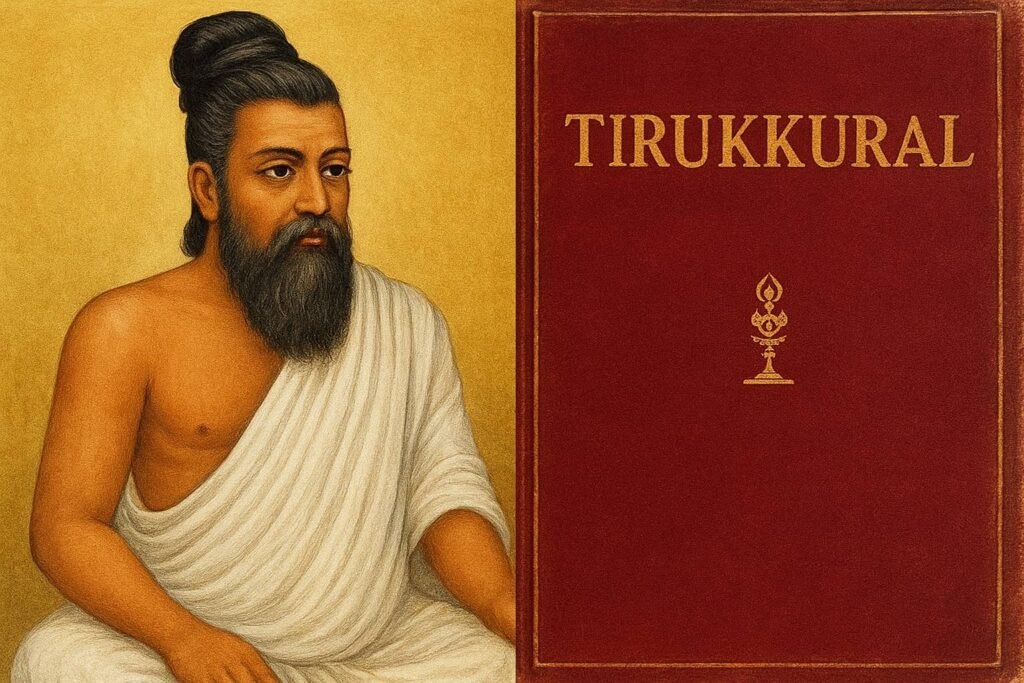


Overview: The Tirukkural, written by the revered Tamil poet-philosopher Thiruvalluvar, is a timeless classic that stands as one of the greatest works on ethics, morality, and human values. Composed in the Tamil language, this masterpiece is renowned for its universality and secular outlook, transcending barriers of time, culture, and religion. Through its 1,330 couplets—each crafted with just seven concise words or kurals—the text imparts profound wisdom on virtues such as non-violence, truthfulness, self-restraint, gratitude, hospitality, and kindness. Moreover, it offers deep insights into human relationships, addressing themes of friendship, love, sexual union, and domestic harmony. The Tirukkural continues to serve as a moral compass for humanity, reminding readers that righteousness and compassion are the true measures of a meaningful life. Its enduring message echoes through ages—guiding hearts, shaping minds, and illuminating the path to virtuous living.
The Tirukkural is widely regarded as one of the most significant works in Tamil literature and among the most celebrated of the Patiṟeṉkīrkaṉakku or “Eighteen Ethical Works.” As a text that has exerted immense influence on Tamil culture, thought, and moral philosophy, the Tirukkural occupies a central position in the intellectual and ethical heritage of South India. Although frequently categorized as a treatise on ethics, it transcends such a narrow classification. Rather, it serves as a comprehensive guide to life, encompassing a wide spectrum of human concerns—virtue (Aram), wealth (Porul), and love or family life (Inbam).
Scholarly consensus suggests that the Tirukkural was composed approximately two thousand years ago, making it one of the oldest extant works of Tamil literature. Despite the passage of centuries, the text continues to resonate with contemporary audiences, attesting to its universality and enduring relevance. Thiruvalluvar’s ability to encapsulate profound philosophical and ethical insights in concise couplets demonstrates a remarkable synthesis of intellectual depth, linguistic precision, and poetic elegance. The Tirukkural not only reflects the moral and cultural foundations of Tamil civilization but also engages with timeless human values that transcend cultural and temporal boundaries.
Furthermore, the influence of the Tirukkural extends beyond literary and cultural domains. It is often cited that Mahatma Gandhi’s philosophy of non-violence drew inspiration from its teachings, underscoring the text’s global ethical significance. In a world enriched with countless texts, scripts, and languages, revisiting the Tirukkural offers an opportunity to rediscover timeless wisdom. It reminds us that learning and reflection know no age or boundary—it is never too late to learn from the ancient.
This write-up explores the Tirukkural as a timeless source of moral and ethical wisdom, offering enduring principles for a virtuous and meaningful life. It reflects on how this ancient Tamil classic continues to inspire ethical thought and righteous living in the modern world. I seek to understand how this ancient Tamil text, while deeply rooted in its cultural context, provides practical insights relevant to everyday living and maintains a secular and universal outlook that transcends cultural, religious, and temporal boundaries. By engaging with the Tirukkural’s treatment of fundamental aspects of the human experience, I hope to uncover lessons that continue to speak to individuals across backgrounds and belief systems.
In addition, this study intends to highlight the unique literary structure of the work—its 1,330 concise couplets (kurals), each composed of merely seven words—which greatly contribute to its accessibility, memorability, and clarity. Unlike many other ancient texts, the Tirukkural conveys profound philosophical and ethical ideas in a remarkably simple and comprehensible manner, enabling readers to grasp, reflect upon, and internalize its timeless teachings with ease.
If we look back, the Tirukkural gained renewed recognition in the early nineteenth century when Francis Whyte Ellis, a British civil servant and distinguished scholar of Tamil and Sanskrit, introduced the text to the wider academic world. His efforts in discovering, studying, and publishing the work played a crucial role in bringing this timeless masterpiece into broader intellectual and literary discourse. Composed in classical Tamil, the Tirukkural is traditionally regarded as part of the post-Sangam literature and is classified among the Patiṟeṉkīrkaṉakku—the “Eighteen Lesser Texts.” Despite this classification, the Tirukkural transcends the boundaries of its category through its universal moral vision, literary excellence, and profound philosophical depth. Its preservation and continued study over two millennia stand as a testament to its enduring cultural and ethical significance.
Classification of the Thirukkural becomes necessary to understand its features. The Thirukkural, written by the revered Tamil poet-saint Thiruvalluvar, is divided into three major sections, each addressing a fundamental aspect of human life — Aram (virtue), Porul (wealth), and Inbam (love). Together, these sections form a comprehensive moral and philosophical framework that guides individuals toward righteous living, social harmony, and personal fulfillment. The first section, Aram (Dharma), consists of 380 couplets (kurals) and deals with virtue, moral conduct, and righteous living. It is further divided into four parts: the Prologue, Domestic Virtue, Ascetic Virtue, and Fate.
The second section, Porul (Artha), comprises 700 kurals and focuses on wealth, governance, and statecraft. It explores themes such as royalty, ministers of state, essentials of administration, methods of acquiring wealth, military excellence, friendship, and various other aspects of public life. The third and final section, Inbam (Kama), contains 250 kurals and centers on love, emotions, and family life, divided into two parts: pre-marital and post-marital love. In total, the Thirukkural consists of 1,330 couplets (Aram – 380, Porul – 700, Inbam – 250), reflecting Thiruvalluvar’s remarkable ability to encapsulate the entire spectrum of human experience within concise and profound verses.
In the Tirukkural, Thiruvalluvar presents a comprehensive vision of governance that reflects his profound understanding of political organization and moral responsibility. His concept of polity and administration is grounded not in democracy but in a system of enlightened monarchy. Thiruvalluvar envisions an ideal state ruled by a just and virtuous king—one who governs without self-interest or realpolitik. The ruler’s primary duties are defined as the production, acquisition, preservation, and equitable distribution of wealth. According to Thiruvalluvar, a king must possess the essential elements of power and stability—an efficient army, adequate food resources, capable ministers, trustworthy allies, and strong fortifications.
A central feature of Thiruvalluvar’s political thought is his emphasis on justice and the rule of law. He portrays the ideal state as one distinguished by law and order, where justice is administered impartially and equally to all. In his view, it is not brute force or the sword that secures victory, but the sceptre—symbolizing justice and righteous authority. Thus, the king emerges as both a moral guardian and a social planner, entrusted with maintaining harmony and fairness throughout the realm.
Thiruvalluvar also elaborates on the essential role of administrators in ensuring the smooth functioning of the state. The king, he asserts, must rely on wise ministers, courageous soldiers, and competent officials for effective governance. Ministers are described as the “eyes of the king,” and great care is urged in their selection. The state, he notes, must also maintain diplomatic missions and a network of envoys to foster relations with other kingdoms while developing an efficient system of espionage for internal and external security. However, Thiruvalluvar cautions the ruler against publicly honoring spies, underscoring the need for discretion in statecraft.
In matters of warfare, Thiruvalluvar advises that the king should ensure both strong defensive and offensive capabilities, emphasizing the importance of well-fortified structures and a disciplined, fearless army. Yet, despite recognizing the necessity of military preparedness, Thiruvalluvar is far from glorifying war. On the contrary, he denounces warfare as a destructive evil that should not be desired—even in jest. His political philosophy, therefore, upholds peace, justice, and moral integrity as the true foundations of a prosperous and righteous state.
Thiruvalluvar’s reflections on economic life in the Tirukkural offer remarkable insights that remain relevant even today. Although his ideas do not form a systematic treatise on economics in the modern sense, they present a deep moral and social commentary on economic activity. Thiruvalluvar emphasizes the interdependence between poverty, prosperity, and societal well-being. He condemns poverty not merely as a material condition but as a source of human suffering and moral decline. In contrast, he advocates for the pursuit of prosperity through righteous and cooperative means, envisioning an economy grounded in collective effort and mutual benefit—one in which wealth is generated and shared for the common good of society.A central pillar of Thiruvalluvar’s economic philosophy is his reverence for agriculture. He exalts the farmer as the true backbone of economic stability, describing those who cultivate the land as the “supporters of the world.” To him, agriculture is not only the most essential form of livelihood but also the foundation of social and economic order. Thiruvalluvar’s appreciation for agrarian life underscores his belief in productivity, self-sufficiency, and harmony with nature.
Beyond material production, Thiruvalluvar highlights social responsibility and community welfare as integral to a prosperous society. He upholds the spirit of service and collective advancement, asserting that contributing to the progress of one’s community is among the noblest of human pursuits. Through these timeless teachings, Thiruvalluvar offers an economic vision anchored in ethics, compassion, and sustainability—principles that continue to inspire contemporary debates on equitable and inclusive development.
Concluding Reflections
In a nutshell, the Tirukkural of Thiruvalluvar stands as an enduring testament to the universality of moral and ethical wisdom. Though composed over two millennia ago, its teachings continue to hold profound relevance in the modern world, addressing the timeless concerns of human life—virtue, wealth, and love—with remarkable clarity and balance. The text transcends cultural and religious boundaries, offering guidance that is both practical and philosophical, inspiring individuals to lead lives grounded in integrity, compassion, and social responsibility.
In today’s fast-paced world, marked by moral uncertainty, social inequality, and environmental strain, the Tirukkural stands as a timeless moral compass. It reminds us that prosperity must rest on the foundation of ethics, that governance must be rooted in justice, and that love must be guided by empathy and respect. Its enduring message—that inner virtue and social harmony are the true measures of progress—makes the Tirukkural not merely an ancient Tamil text, but a living manual for humanity’s collective conscience.
Her academic interests lie at the intersection of history, culture, and civilizational studies. In addition to her teaching career, Apparna has worked as a content writer and editor at a law firm, where she curated and developed material for a weekly current affairs magazine. Currently in the final year of her B.Ed. program, she is actively preparing to pursue a Ph.D. in History, aspiring to make a meaningful contribution to academia and public discourse through research and scholarship..