


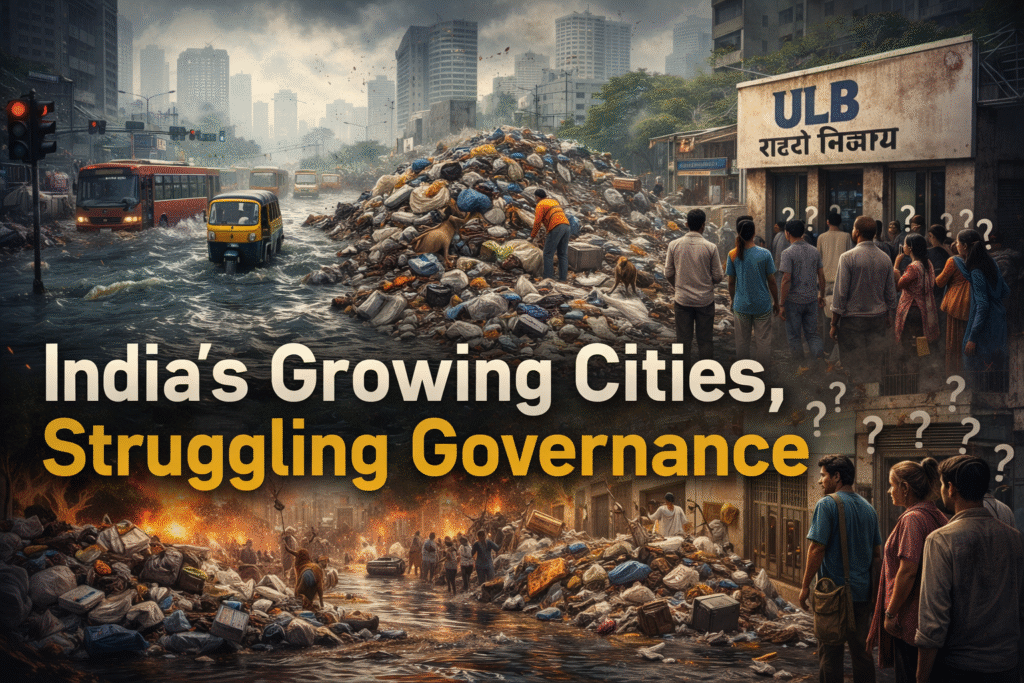


India’s cities are growing faster than its governance systems can handle. Streets flood after every downpour, garbage piles up overnight, and citizens often don’t know whom to even approach when something goes wrong. What is supposed to be the closest tier of democracy-the Urban Local Bodies (ULBs)-is, in practice, a peripheral player in its own jurisdiction. Despite constitutional recognition thirty years ago, India’s third tier still functions with limited power, fragmented responsibilities, and fragile finances. This isn’t a technical failure; it’s a political one. Cities remain governed by a maze of agencies that operate in silos, most reporting upward to state governments rather than outward to city residents. And as India heads toward an urban population of 800 million by 2050, this mismatch between constitutional promise and ground reality threatens to become a structural crisis. If India is serious about becoming a global economic powerhouse, ULBs must be allowed to grow up-not just exist.
Why Cities Matter?
Urban India today accounts for roughly two-thirds of GDP, hosts most high-value jobs, and attracts the bulk of new investments. Cities are where innovation happens, where capital flows, and where aspirations converge. The pace of urbanisation is not slowing; it is accelerating.
ULBs, in theory, should be the backbone of urban governance. They run the show on waste, water, sanitation, local roads, community spaces, and neighbourhood level infrastructure. They are meant to be democratic, locally grounded, and responsive. But in practice, they remain structurally weak-caught between the expectations of citizens and the control of state governments.
A Short History of Missed Opportunities
Local self-governance in India is older than the Indian state itself. Ancient cities had community-led bodies managing essential services. But colonial rule replaced this with a bureaucratic system built to prioritise trade and control, not local empowerment.
The Dutch established the first municipality at Kochi in 1664. The British soon followed with municipal corporations in Madras (1687), Calcutta, and Bombay. Governance remained top-down until Lord Ripon’s 1882 resolution, which gave Indians their first meaningful introduction to elected local governments. This, however, did not fundamentally change power distribution.
After independence, elected municipalities continued, but they lacked constitutional protection. States could dissolve them at will. Their powers were optional, not guaranteed. Several committees called out this fragility, but reforms stagnated until 1992.
The 74th Constitutional Amendment tried to fix the problem. It created a uniform structure, introduced reservations, mandated five-year terms, established Finance Commissions, and listed 18 municipal functions.
It was a significant step-but the key weakness remained:
States still decide how much power, money, and authority ULBs actually get.
This single flaw explains much of the dysfunction we see today.
What the Constitution Says
Part IXA of the Constitution gives ULBs a clear structure:
• Nagar Panchayats for transitioning areas
• Municipal Councils for small towns
• Municipal Corporations for big cities
• Directly elected councillors
• Reserved seats for SCs, STs, and women
• State Finance Commissions to review municipal finances
• State Election Commissions for municipal polls
• 18 functions in the Twelfth Schedule
• Metropolitan Planning Committees for large regions
On paper, ULBs should be fully functional governments.
But on the ground, states have used the vast discretion left to them to:
• retain control over major functions (water, transport, sewerage)
• appoint municipal commissioners loyal to the state
• create parallel agencies and SPVs
• restrict taxation autonomy
• delay or avoid elections
• override local planning through state master plans
The result is a peculiar situation: cities look empowered but operate like administrative outposts.
The Architecture of a Weak System
The Deliberative Wing: Representatives Without Real Authority: Residents elect councillors who debate policies, pass budgets, and theoretically shape the city’s future. But the mayor is often ceremonial, and the council rarely controls major departments. Councillors may be held accountable by citizens, but they lack the power to act.
The Executive Wing: Authority Without Local Accountability; The real power usually sits with the Municipal Commissioner-an IAS or state cadre officer appointed by, and answerable to, the state government. This creates a structural mismatch: citizens vote for councillors but end up negotiating with an official whom they never elected.
Ward Committees: The Suppressed Space for Participation: Ward committees were meant to be the channels through which residents directly shape governance. Yet in many cities they are either non-functional or deliberately weakened. States often fear decentralisation within decentralisation.
Remedying this gap is essential because the ward level is where urban governance truly touches daily life.
The Major Challenges Keeping ULBs Fragile
Severe Fiscal Weakness- The Comptroller and Auditor General of India (CAG) found a 42% gap between the responsibilities assigned to ULBs and the resources available to them. This is a staggering figure-it means cities are expected to deliver services with less than two-thirds of the money they need. Only 32% of municipal revenue is raised internally, and the rest depends on unpredictable transfers from higher levels of government.
Some cities cannot even cover basic maintenance costs. In add to this- low user charges, politically restricted tariffs, outdated property tax systems, massive arrears, weak assessment and collection, lack of digital integration, staff shortages (up to 37% vacancies in some ULBs). This financial paralysis then cascades into weak service delivery.
Fragmented Governance Across Multiple Agencies- Perhaps the biggest structural flaw is fragmentation. Cities are governed not by one body but by at least six to twelve different agencies, often reporting to different state departments. Examples:
• Development Authorities
• Water Supply Boards
• Sewerage Boards
• Metropolitan Transport Corporations
• Smart Cities SPVs
• Pollution Control Boards
• Housing Boards
These agencies operate independently, rarely coordinating with the municipal council. When everyone is responsible, no one is accountable.
Inadequate Planning and Weak Enforcement
Urban planning in India suffers from two chronic problems:
1. Many cities do not have updated master plans.
2. Even where plans exist, they are inconsistently implemented.
Most ULBs do not have: GIS-enabled mapping, Real-time data systems, Digital property records, Climate-resilient planning, Disaster-preparedness frameworks, Performance dashboards. Cities end up reacting to crises rather than preventing them.
Poor Borrowing Capacity- Cities cannot borrow effectively because their finances are too weak. This locks them into dependency on state and central grants. Without the ability to raise capital, cities cannot invest in the large infrastructure that rapid urbanisation demands.
Weak Citizen Accountability Mechanisms- Mechanisms like ward committees, area sabhas, social audits, and public consultations often remain symbolic. Without citizen pressure, services deteriorate, and local democracy weakens.
What reforms may look like
Strengthening ULBs is not an administrative exercise- it is a political reform project. States must be willing to give up control, something they have resisted for decades. But the costs of maintaining the status quo are rising sharply.
Genuine Fiscal Empowerment- Cities need authority to set realistic user charges, modernised property tax systems (GIS, annual revaluations, digital billing), a guaranteed share of state taxes, predictable, formula-based transfers, more freedom to borrow and manage debt. A city cannot govern if it cannot fund itself.
Clear Functional Devolution- states must transfer the Twelfth Schedule functions fully not selectively. Water supply, sanitation, urban transport, planning, and building regulation must lie with the elected municipal government, not para-statal bodies.
Professionalising Urban Administration- ULBs need skilled urban planners, public finance experts, data analysts, environmental and climate specialists, engineers with modern training, a municipal cadre independent of state interference. Capacity building should be systematic, not project based or sporadic.
Strengthened Ward-Level Governance- Ward committees and area sabhas must be activated with- clear powers, annual ward budgets, public reporting, social audits, open grievance mechanisms. This is the only way to rebuild trust and accountability at the local level.
Integrated and Coordinated Planning- Cities need institutions that bring together- ULBs, development authorities, transport agencies, utility boards, environment agencies, state departments. Metropolitan Planning Committees should be made functional with real authority-not left as constitutional ornaments.
Technology driven transparency and Citizen Engagement- Cities should adopt open data platforms, real-time dashboards, mobile grievance systems, participatory budgeting, online tracking of municipal works. Transparency is the foundation of trust.
Conclusion
ULBs are meant to be the grassroots of urban democracy. They are the only institutions that stand between citizens and the state daily whether the issue is streetlights, waste collection, drainage, or encroachments. Yet they remain disempowered, financially dependent, and structurally constrained. India risks entering 2050 with mega cities that cannot manage basic services, purely because political incentives favour centralisation, not decentralisation. If India wants its cities to be competitive, liveable, and resilient, the third tier needs more than constitutional recognition it needs real power, financial autonomy, and professional capacity. Citizens must be empowered to hold local governments accountable, and local governments must be empowered to govern. The country’s economic ambitions and social fabric both depend on this shift. Strong ULBs are not just a governance reform; they are a foundation for a modern, urban India that works efficient, democratic, and genuinely responsive to the people it serves.
References
1. Rawat, S. (2025). Does urban local governance matter? Evidence from India. arXiv. https://arxiv.org/abs/2511.06562 arXiv
2. Sahasranaman, A., & Bettencourt, L. M. A. (2018). Urban geography and scaling of contemporary Indian cities. arXiv. https://arxiv.org/abs/1810.12004 arXiv
3. Mishra, S., & Das, S. (2022). Effective city planning: A data-driven analysis of infrastructure and citizen feedback in Bangalore. arXiv. https://arxiv.org/abs/2211.03186 arXiv
4. “Cash-starved civic bodies struggle … generate only 32% of revenue from own sources: CAG.” The Times of India. (2024, November 15). The Times of India
5. “What is ailing urban local bodies in 18 states: CAG flags 42% resource-expenditure gap, 37% staff vacancy in urban local bodies.” The Indian Express. (2024, November 14). The Indian Express+1
6. “Audit covering 2015 to 2020: Urban bodies lack in power, resources, finds CAG.” The Indian Express. (2024, August 14). The Indian Express
7. “Significance of empowering local bodies for effective urban governance in India.” The Indian Express. (2024). The Indian Express
8. “India’s urban crisis deepens as states choke city-level governance.” Vision IAS / Business Standard summary. (2025, October 23). VISION IAS
9. PolSci Institute. (2023). The 74th Amendment: Strengthening Urban Local Bodies in India. PolSci Institute. Political Science Institute
10. PubAdmin Institute. (2023). Evaluating the Effectiveness of Urban Local Governance Post 74th Amendment. PubAdmin Institute. Public Administration Institute
11. NextIAS. (2024, November 28). India’s urban infrastructure: Financing, needs, and reality. NextIAS. NEXT IAS
12. “Challenges in urban local governance.” IASGyan / NITI Aayog summary. (2024). IASGyan
Her research interests lie in public policy, governance, and economic development. She has previously worked on independent and organizational research projects exploring themes such as jobless growth, CSR spending, and structural inequities in development. Her prior experiences include roles at the International Council on Human Rights, Peace, and Politics, and at Rebounce, where she contributed to policy papers and data-driven research..