


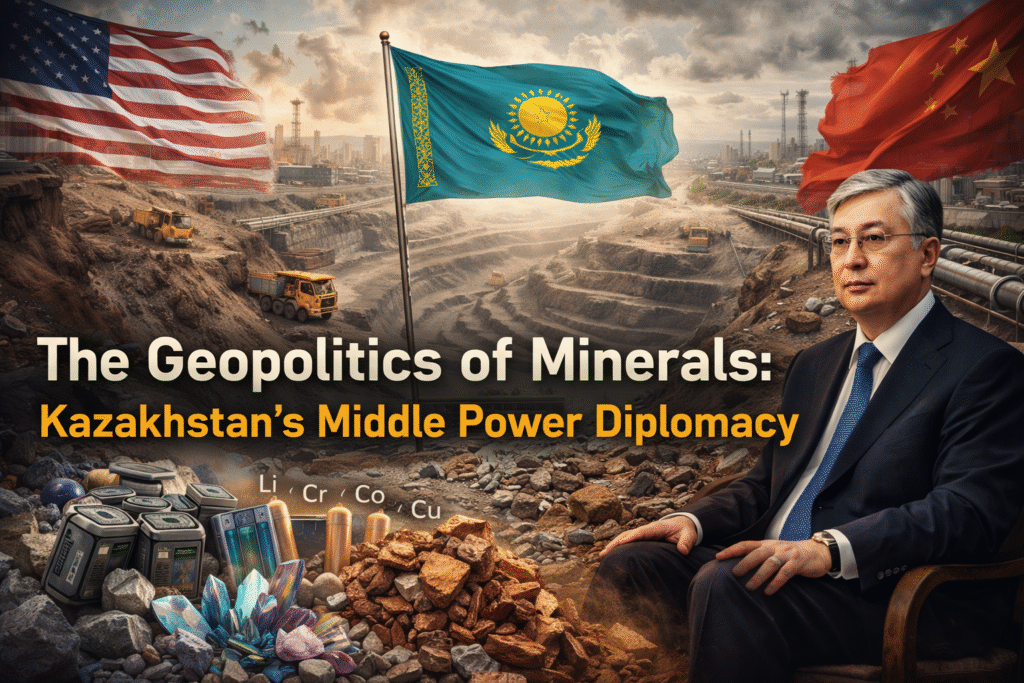


Critical minerals are becoming essential for today’s hostile war scenario and thereby it has become a new weapon in geopolitics. Critical minerals are quite essential for semiconductor, defence system, renewable energy technologies and electric vehicles batteries.( world energy outlook) . The current mutual problem for every country is China’s dominance in refining and capacity as even the European Union ‘s Critical Raw mineral act state dependence on china as strategic vulnerability(European commission- critical raw mineral act 2025)
Kazakhstan is emerging as a key player in this critical mineral race due to it’s strategic diplomacy and middle power role.
Kazakhstan offers a direct trade route to Europe via the middle corridor / trans caspian international route as it is positioned between China and Russia. Kazakhstan is one of the nation’s following a multi vector diplomacy collaborating with US, China, Russia, EU simultaneously. Kazakhstan also accounts for about nearly 43 percent of the critical mineral and thereby the US is negotiating trade deals to bypass Chinese hegemony on critical minerals.
KAZAKASTAN CRITICAL MINERAL RESERVE AND ECONOMIC PROFILE
Kazakhstan is top uranium producer accounting nearly 39% of the global output~14% of world’s uranium reserves. Even US is partnering with the country in developing one of the world’s largest tungsten deposits (JORC 410,100t). In April, 2025, Kazakhstan announced a
<20 million tons Rare Earths (REE) deposits and thereby Mining and quarrying remains a mainstay of the economy and it accounts the industry shares of GDP as 26.8 % as of 2023. The shifting ownership and great power capital in uranium is clearly visible as Rosatom (Russia) is selling Kazakh uranium assets to Chinese firms.
Strategic Geography- Heart of Eurasia: Most EU- China traffic transits Kazakhstan and it's illustrated by khorgos dry port on China border that handled nearly >2000 China- EU trains. Cargos via the middle corridor hit ~ 4.1 million tones in Jan- Nov 2024 while current capacity is ~ 6 million t/yr.The oil export dependence is further highlighted by Caspian Pipeline Consortium (CSP) carrying nearly 63 million tons handling nearly 80 percent of Kazakh oil. More emphasis thereby laid on diversification as CPC lies near Russia’s Novorosiyyak. However, Kazakhstan is still pursuing the westward alternatives via Azerbaijan/Georgia/Turkiye through the Baku- Tbilhsi- Ceyhan (BTC) pipeline- targeting nearly 2.2mt with discussion to scale nearly to 5-7mt/yr. The usage of the same corridor (Khorgos rail, Middle corridor sea – rail, and westbound rail exports) underscores the importance of non – Russian Exports paths for future critical mineral concentrates and value added products, for instance, uranium fuel components are a strategic hedge for partners seeking China/Russia bypass logistics.
GREAT POWER COMPETITION ON CRITICAL MINERALS
The current geopolitical scenario very illustrates the fact that the new Cold War is being fought in mines, not missiles.
According to the International Energy Agency 2024 Report, the demand for critical minerals is projected to rise up to nearly seven times by 2020.China, Russia and US are not merely competing for deposits, but for control over entire extraction- to- processing value chains. Kazakhstan has become a strategic chessboard in this mineral powered race for technological supremacy.
The unquestionable dominance of China is due to the 70-90% of the global earth processing and refining, while most countries only extract ores. Though, The mining of minerals is carried out in different countries like Australia, UK etc but China dominates the Mid-stream segment (separation and refining) which creates dependency. This geopolitical mineral war is further intensified by Beijing’s economic statecraft to weaponize mineral power chains. The restrictions on export of critical minerals is meant to political leverage and strategic bargaining power. In July 2023, China imposed export controls on two essential minerals for semiconductor industry (gallium, geranium) and it severely impeded the US and EU chip manufacturing. Further, the expansion of export controls in graphite is an example of its assertion to control the production of EV batteries. China’s mining companies have equity stakes or mining investments in 120+ critical mineral projects across 30 countries. In Africa, Chinese companies control nearly 70% of the cobalt mining in the Democratic Republic of Congo (DRC). The bigger picture is control over refining and mineral plants so that raw ore should return back to China. The building of digital infrastructure in mining countries (small ports, logistics) allows China to integrate data flows with commodity flows.
The US officially identifies Kazakhstan as a priority critical mineral partner in its 2025 critical mineral list highlighting as an opportunity for diversification in tungsten, rare earths and uranium. The US further uses the economic incentives like inflation Reduction Act (IRA) that allows tax credits for EVs only if critical minerals come from US partners(not China) and Kazakhstan thereby can classify as a “trusted partner” for the IRA. The IRA, if combined with the Defense production act of the US, can further yield great benefits since it allocates $6 billion to secure non Chinese supply chains. The US strategy aims to reallocate the midstream refining segment out of China and thereby to build refining/processing capacity in Kazakhstan.
Russia acts as a historical security guarantor and thereby exert political pressure that Kazakhstan must consider while negotiating Strategic deals. In January 2022, Russia led CSTO Collective Security treaty Organization provided assistance to Kazakhstan. Further the energy infrastructure leverage can be illustrated by the Caspian pipeline consortium (CPC) – the main route for Kazakh oil to black sea that is jointly controlled by Russian and western energy firms. Russian regulators actions in 2025 severely disrupted Kazakh’s export capacity thereby reinforcing Moscow’s geopolitical weight. ROSATOM (Russia’s state nuclear cooperation) was selected in 2025 to build Kazakhstan’s first nuclear power plant and such involvement allows Moscow to control strategic fuel supplies. Beyond energy and nuclear ties, Russia also employs economic and political instruments like banking links, migrant labor flows and preferential trade in Eurasian Economic Union(EAEU).
It’s imperative for Kazakhstan to balance the strategic interest of balancing out the deepening ties with US(refining) and China(logistics) on one hand and on the other, managing Moscow’s commercial flows.
KAZAKHSTAN AS MIDDLE POWER
In IR theory, middle powers often act as stabilizers and mediators between major powers. (Copper, 1997). Kazakhstan often demonstrates this classic middle power theory through triad-it leverages geography (heart of Eurasia), resources(critical energy minerals) and neutrality. It brands itself as a “ platform for dialogue” and hosts peace talks such as the Astana peace process on Syria(2017) .
Multivector diplomacy is the core principle of foreign policy of the country which commits to an “equidistant and mutually beneficial relationship”with the US, China, EU, Russia and the islamic world. This measure is essential to ensure strategic autonomy and not to align exclusively with any major power for instance it hosted the US strategic dialogue, participated in China’s Belt and Road initiative and is an active member of Russian lead CSTO and EAEU.
The country often deploys its soft power tools(stability, predictability, and investment climate),and hence it differentiates itself from volatile neighbors.
In the World Bank’s Ease of doing business, Kazakhstan ranks 34th country in the indicator for “protecting investors” and has attracted US $150 billion in FDI since independence.
Kazakhstan has further positioned itself as a neutral hub for east-west finance and signed cooperation MOUs with the London stock exchange, NASDAQ, and Shanghai stock Exchange. To further enhance its soft power, Kazakhstan uses English law arbitration through the Astana international financial center that courts effectively Chinese, western and English investors.
The institutional balancing through multilateral organizations like Shanghai Cooperation Organisation (SCO) , Organization of Turkic Stars(OTS) and is essential for diversification. Such multilaterism enabled Kazakhstan to access western capital, Chinese infrastructure and Russian markets simultaneously.
Thus, the country quite effectively exemplifies “strategic equidistance” – leveraging its mineral wealth, geographic Centrality and Reputation for neutrality to function as a “middle power” capable of engaging great powers without capitulating to any single power.
IMPLICATIONS FOR INDIA.
India’s strategic goal remains to reduce Chinese dependence as it currently imports 93% of its rare earth elements and 70% lithium compounds from China. India’s Ministry of Mines has also recognised this vulnerability in its “Critical Mineral strategy 2023”. In such a geopolitical mineral crisis, Kazakhstan emerges as a natural partner in India’s diversification strategy. India’s state owned nuclear cooperation(NPCIL) collaborates with kazatomprom. This technology engagement is further enhanced by the launch of Connect Central Asia Policy in 2012 by the Ministry of External Affairs. It was subsequently expanded in 2023 as Kazakhstan remained cornerstone in this framework due to its political connectivity and shared goals of critical minerals. The Indie Central Asia summit (2022) further reaffirmed India’s focus on critical mineral cooperation, chahabar port connectivity and International North South corridor (INSTC). Kazakhstan’s engagement with INSTC offers India, a great opportunity and hence a logistic alternative to China’s BRI network, connecting Indian ports to Eurasia via Iran and the Caspian. This route could significantly reduce over-dependence on maritime routes vulnerable to geopolitical tensions and thereby facilitate a direct trade in critical minerals.
Such partnership offers a mutual opportunity for India and Kazakhstan and offers a multipolar non-aligned framework- aligning with India’s strategic autonomy and Kazakhstan’s multivector diplomacy.
CONCLUSION
Kazakhstan is not merely a landlocked state in Central Asia but a decisive mineral partner by pursuing the policy of multivector diplomacy
Kazakhstan has quite effectively diversified its links with global powers like the US, Russia and islamic world while maintaining its sovereignty. The transition of green politics is underway and yet a anchor in policy making for international realm
References
1. https://timesca.com/kazakh-khorgos-still-a-vital-trade-link-between-china-and-europe/
2. https://www.geopoliticalmonitor.com/the-middle-corridor-a-route-born-of-the-new-eurasian- geopolitics/
3. https://thediplomat.com/2025/03/kazakhstan-aims-to-increase-oil-exports-via-btc-pipeline/
4. https://oilprice.com/Latest-Energy-News/World-News/Kazakh-CPC-Oil-Exports-Capped-at- 700000-bpd-After-Russian-Suspension.html
5. https://www.reuters.com/markets/commodities/azerbaijan-talks-increase-kazakh-oil-transit- 5-7-mln-t-2024-06-06/
6. https://www.dailysabah.com/business/energy/azerbaijan-kazakhstan-mull-lifting-oil-transit- via-btc-by-2027
7. https://astanatimes.com/2025/09/kazmunaygas-resumes-oil-exports-through-baku-tbilisi-ce yhan-pipeline/
8. https://www.orfonline.org/research/the-middle-corridor-reviving-connectivity-for-eu-central- asia-trade-and-india-s-strategic-imperative
9. https://www.iea.org/reports/critical-minerals-market-review-2024
10. https://pubs.usgs.gov/periodicals/mcs2024/mcs2024.pdf
11. https://www.iea.org/reports/critical-minerals-market-review-2024
12. https://www.csis.org/analysis/chinas-critical-mineral-strategy
13. https://www.brookings.edu/articles/chinas-role-in-africas-critical-minerals/
14. https://carnegieendowment.org/2024/02/13/chinas-digital-silk-road-map-digital-control/
15. https://qazinform.kz/en/news/us-drafts-2025-critical-minerals-list-kazakhstans-opportuniti es-4468876
16. https://www.energy.gov/policy/articles/inflation-reduction-act-guide-clean-energy-investme nts
17. https://www.defense.gov/News/Releases/Release/Article/3724958/dod-invests-6b-in-critic al-mineral-and-battery-supply-chains/
18. https://www.atlanticcouncil.org/blogs/new-atlanticist/kazakhstan-critical-minerals-and-us-f oreign-policy/
19. https://www.reuters.com/world/asia-pacific/russia-led-bloc-starts-pulling-troops-out-kazak hstan-2022-01-13/
20. https://www.reuters.com/business/energy/russian-order-slashes-kazakh-oil-export-capacit y-amid-opec-row-2025-04-01/
21. https://www.reuters.com/business/energy/caspian-pipeline-consortium-completes-cleanu p-operation-after-accident-spill-2025-08-30/