


Issue Brief:

Maduro’s Custody and Legal Proceedings
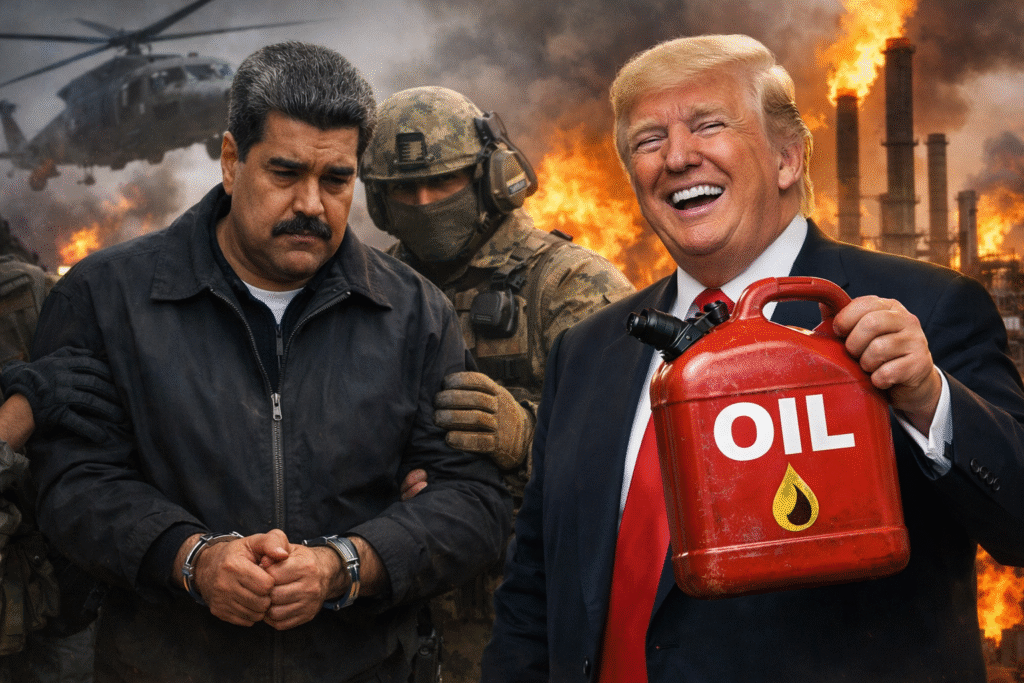
Following the U.S. strikes and the reported capture of Venezuelan President Nicolás Maduro and his wife Cilia Flores, U.S. authorities confirmed that they have been transported to U.S. custody and are expected to face criminal charges, particularly related to narcoterrorism and drug trafficking, in the Southern District of New York. The move marks an unprecedented escalation in U.S. action against a sitting head of state and raises profound legal, diplomatic, and normative questions regarding sovereignty and international jurisdiction.
Trump Administration’s Strategy
President Donald Trump stated that the United States intends to temporarily “run Venezuela” until a “safe, proper and judicious transition” to a new governing authority can be established. He explicitly referenced the involvement of U.S. oil companies in efforts to modernise and renovate infrastructure, highlighting Venezuela’s vast petroleum reserves as a central pillar of the post-intervention plan.
Trump also suggested that U.S. “boots on the ground” could be deployed if necessary, indicating preparedness for an extended American presence beyond limited air strikes and special operations. This statement has intensified concerns that the operation may evolve into a prolonged occupation or trusteeship-style arrangement.
Strategic and Symbolic Significance
Policy analysts and strategic commentators have described the operation as a decisive reassertion of U.S. power in the Western Hemisphere. Symbolically, the intervention signals to global rivals—particularly Beijing and Moscow—that Washington remains willing to employ direct military force to reshape political outcomes in its perceived sphere of influence.
Diplomatic Escalation and International Response
United Nations Engagement
The UN Secretary-General publicly warned that the U.S. military action sets a “dangerous precedent” and urged strict adherence to international law. At the request of Venezuela’s allies, including Colombia, Russia, and China, the UN Security Council convened an emergency meeting to address the crisis.
This development is significant, as it represents one of the earliest formal multilateral attempts to assess the legality and legitimacy of the intervention. The deliberations underscore unresolved questions surrounding unilateral use of force in the absence of explicit Security Council authorization.
Regional Splits and Latin American Reactions
Latin America has responded in a sharply divided manner. Brazil, Mexico, and several left-leaning governments condemned the strikes as a blatant violation of Venezuelan sovereignty and international law. They warned that such actions risk destabilising the region and reviving a legacy of external intervention.
Conversely, certain opposition figures and political leaders in the region viewed the removal of Maduro as a potential opening for democratic restoration, expressing cautious optimism about Venezuela’s political future. Colombia, while expressing concern, called for immediate multilateral diplomatic engagement through the Organization of American States and the United Nations rather than unilateral action.
Major World Powers
China described the operation as deeply shocking and a violation of international law, framing it as an example of coercive hegemony while reaffirming its long-term economic and strategic engagement with Latin America.
Cuba condemned the U.S. action as “state terrorism,” highlighting its close energy ties with Venezuela and warning of severe economic and humanitarian consequences for the region.
European Union leaders urged restraint and respect for the UN Charter. While critical in tone, their statements stopped short of explicitly declaring the U.S. intervention illegitimate, reflecting internal divisions within the bloc.
Governance Vacuum and Internal Venezuelan Politics
Venezuela’s Power Struggle
In the immediate vacuum following Maduro’s capture, Vice President Delcy Rodríguez declared that Maduro remains the legitimate president and denounced the U.S. action as unlawful and illegitimate. Backed by Venezuela’s Supreme Tribunal of Justice, she asserted continuity of constitutional authority.
However, the U.S. position effectively delegitimises such claims unless Venezuelan institutions align with Washington’s preferred transition framework. This has triggered an acute constitutional crisis, with the possibility of multiple competing authorities each asserting legitimacy.
Opposition Dynamics
Prominent opposition leader María Corina Machado openly welcomed the U.S. operation and pledged to participate in rebuilding a “new Venezuela.” While this reflects genuine domestic and diaspora support for political change, it has also intensified polarization within Venezuelan society and complicated prospects for a consensual transition.
Civil and Military Response
Satellite imagery and ground reports indicate significant damage to Venezuelan military installations, particularly around Caracas. This suggests the intensity of the strikes and raises concerns about potential armed resistance from loyalist military units, paramilitary colectivos, or fragmented security actors operating outside centralized control.
Legal and Normative Implications
International Law Controversies
Legal scholars and international law experts argue that the U.S. military action likely violates core principles of the UN Charter, particularly Article 2(4), which prohibits the use of force except in cases of self-defense or with Security Council authorization. Claims that the operation targets narcotics trafficking have been widely criticized as insufficient to meet the legal threshold of an armed attack.
Within the United States itself, several lawmakers have questioned the absence of Congressional authorization, raising constitutional concerns over executive war powers and democratic accountability.
Normative Erosion
The intervention has alarmed many Global South and non-aligned states, who view it as a regression toward unilateral interventionism. Critics argue that such actions undermine decades of efforts to strengthen multilateralism, sovereign equality, and peaceful conflict resolution.
Broader Geopolitical and Economic Impacts
Energy Markets and Oil Interests
The explicit linkage of the intervention to Venezuela’s oil sector underscores the centrality of energy resources in U.S. strategic calculations. Plans to involve American oil companies indicate long-term economic and geopolitical interests that extend beyond stated security or anti-narcotics objectives.
Regional Security and Migration
Neighbouring states, particularly Colombia and several Caribbean nations, are preparing for potential humanitarian displacement, refugee flows, and cross-border security challenges as instability and uncertainty deepen within Venezuela.
Global Power Competition
The crisis has intensified great-power competition in Latin America, a region historically shaped by the Monroe Doctrine. Russia and China’s strong opposition suggests the likelihood of deeper strategic engagement with governments resisting U.S. intervention, further complicating regional alignments.
Conclusion: What Comes Next
Although the situation remains fluid, post-strike developments reveal a deeply layered crisis. Diplomatically, the intervention has fractured international consensus and triggered heightened Security Council scrutiny. Legally, it raises fundamental questions about sovereignty, self-defense, and executive war powers. Internally, Venezuela faces a contested political landscape marked by competing claims to authority and risks of instability.
Geopolitically, the episode has revived debates over U.S. hemispheric dominance, great-power rivalry, and resource politics. In academic and journalistic terms, this moment is likely to be studied as a defining episode of twenty-first-century interventionism, testing the durability of international law, multilateral institutions, and regional stability.
About the Author
Wasia Khan is a PhD Scholar of International Relations and Area Studies at MMAJ Academy of International Studies, Jamia Millia Islamia, New Delhi. A graduate in Turkish Language and Literature, she also holds a Master’s in International Relations from the MMAJ Academy of International Studies of the same university. She is Deputy Executive Director of CDFA Research Foundation, and currently serves as the Director of the Division of Strategic & International Affairs.
Disclaimer: The opinions expressed in this article are solely those of the authors and do not necessarily reflect the views of CDFA or any affiliated organisation.