




Introduction
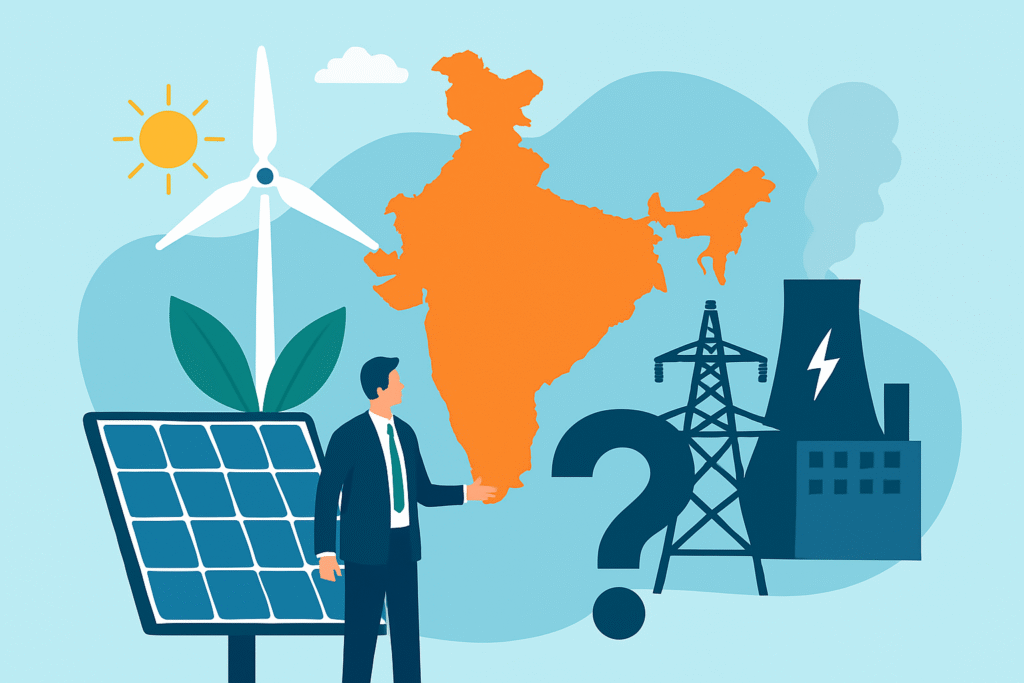
India’s power sector stands at a decisive crossroads in November 2025. On one hand, the country has positioned itself among the world’s top five electricity generators, with solar energy emerging as a symbol of its clean energy ambitions. On the other, unresolved structural challenges—from coal dependency and transmission losses to Discom inefficiencies—continue to weigh heavily on progress.
The urgency of reform is underscored by the Ministry of Power’s directive to resolve nearly 93 GW of renewable energy contracts by the end of this month. With only a fraction of tenders backed by signed agreements, the deadline has become a litmus test for India’s ability to translate capacity into reliable supply.
Simultaneously, the Electricity Amendment Bill 2025, still awaiting finalisation, promises to reshape the sector by opening distribution to competition, strengthening consumer protections, and reducing the burden on state-run Discoms. However, this shift may disproportionately affect poorer regions if private monopolies emerge in the name of competition.
The moment is no longer about numbers or legislation alone; it is about whether India can align its energy transition with the twin imperatives of equity and efficiency. Choices made now will determine whether the country’s vast renewable potential becomes a driver of resilience and growth or, if unresolved, a bottleneck that keeps the sector locked in cycles of crisis and dependence.
Coal Output Problem
Coal remains the backbone of India’s electricity generation, yet its production and delivery face persistent hurdles. A demand–supply mismatch has led to domestic shortfalls, forcing reliance on imports and exposing the sector to global price volatility. Operational and infrastructure constraints—logistical issues, regulatory delays, and land acquisition challenges—further weaken productivity.
Environmental concerns from excessive coal use, safety risks in mining, and complex taxation policies make coal both indispensable and increasingly problematic.
Transmission and Distribution Losses
India has made progress in reducing transmission and distribution losses, bringing them down from nearly 23% in 2014–15 to about 17% in 2023–24. Initiatives like the revamped distribution sector scheme, smart metering, and improved billing have contributed to this.
Yet losses remain high compared to countries like China, where T&D losses stand below 5%. Significant efficiency gains are still required for India to build a reliable and modern power network.
Discom Sector Challenges
India’s distribution companies (Discoms) operate one of the largest electricity networks in the world, but they remain financially fragile. Chronic leakages, poor cost recovery, and structural inefficiencies have made them dependent on recurring government bailouts.
This weak financial base undermines the sector’s ability to sustain reforms, honour contracts, and absorb the rapidly increasing share of renewable energy.
Renewable Energy Progress and Gaps
Despite these challenges, India has emerged as one of the top five power-generating nations with notable dominance in solar capacity. Investments in renewables are rising, supported by international collaborations like the International Solar Alliance and domestic schemes such as the PM Surya Ghar Yojana.
However, actual efficiency and utilisation still lag due to grid constraints and contractual uncertainty.
Legislative Landscape: Electricity Act 2003 and Amendment Bill 2025
The Electricity Act 2003 laid the foundation for modern energy regulation, consolidating laws on generation, transmission, distribution, and trading. The Electricity (Amendment) Bill 2025 seeks to deepen competition, protect consumers, and ensure universal supply.
If implemented effectively, it could open distribution to multiple players, strengthen tariff discipline, and reduce the long-term dependence of Discoms on state support.
Key Developments in 2025
India’s energy sector is steadily pivoting towards renewables. As of June 2025, installed capacity stands at 476 GW, with non-fossil fuels contributing 49%. Solar capacity has risen to over 123 GW, while wind capacity has crossed 52 GW.
Power outages have dropped from 4.2% in 2013–14 to just 0.1% in 2024–25, supported by initiatives like the Green Energy Corridor, FAME II, and the National Green Hydrogen Mission.
Yet two major issues persist:
1. Delays in connecting new renewable projects to the grid.
2. High volumes of signed but unfinished contracts.
The core issue is the grid’s limited ability to absorb intermittent renewable power, resulting in bottlenecks in transmission expansion and reinforcing the financial stress of Discoms.
Electricity Amendment Bill 2025: Key Provisions
The bill introduces several significant changes:
• Multiple distribution licensees may operate in the same geographic area, ending regional Discom monopolies.
• Infrastructure sharing is allowed to avoid duplication of networks.
• Regulators must set tariffs based on actual cost of supply.
• The bill formally defines energy storage systems and enables new market mechanisms such as spot markets, derivatives, contracts for difference, and virtual PPAs.
A High-Level Electricity Council chaired by the Union Power Minister is proposed to streamline coordination between central and state policies.
Criticisms
• Farmers fear higher tariffs if cross-subsidies are removed without proper compensation.
• States raise concerns over federal overreach in a concurrent subject.
• Fears persist regarding privatisation, tariff hikes, and execution challenges.
Amending the electricity framework has been overdue, given the chronic distress of state Discoms. Energy losses alone amount to roughly 2% of India’s GDP, with excessive dependence on electricity for irrigation compounding the burden.
Stakeholder Reactions
Reactions remain mixed. Government and industry experts view the bill as essential to boosting efficiency, competitiveness, and financial viability. Recognising energy storage systems is widely seen as a much-needed step. However, critics highlight risks around privatisation, job insecurity, erosion of state autonomy, concerns over equity and affordability, and significant implementation challenges.
Opportunities Ahead
Significant opportunities remain:
• Expansion of solar, wind, and offshore wind capacity.
• Development of green hydrogen and advanced storage solutions.
• Building a full domestic supply chain from component manufacturing to grid integration.
• Leveraging PLI schemes to boost domestic manufacturing.
• Strengthening distributed renewable initiatives like PM-KUSUM and PM Surya Ghar.
• Growing corporate demand and voluntary adoption of clean energy.
• Rising interest from global investors and multilateral institutions.
• Greater emphasis on policy innovation, clean energy acceleration, and youth-driven regional initiatives.
Governance Gaps and Institutional Weaknesses
A major, often understated barrier to India’s energy transition is the persistent gap between policy ambition and institutional capacity. While the Centre announces high-velocity reforms, missions, and targets, the ability of state institutions—regulators, utilities, land agencies, and local administrations—to operationalise them remains uneven.
State Electricity Regulatory Commissions (SERCs), for instance, often struggle with delayed tariff revisions, political interference, and limited technical manpower. This weakens cost recovery and stalls investment cycles.
Similarly, environmental approvals, land acquisition, and right-of-way clearances for transmission lines continue to suffer from long procedural delays and fragmented decision-making across departments. The result is a widening mismatch: renewable capacity grows faster than the institutions responsible for integrating it.
Even schemes intended to fix governance, such as the Revamped Distribution Sector Scheme (RDSS), face inconsistent implementation and data gaps at the state level.
Policy certainty is another crucial issue. Frequent shifts in state-level renewable purchase obligations (RPOs), retrospective changes to open access charges, and delays in payments to renewable developers create an atmosphere of unpredictability. Investors—especially international ones—continue to view India as a high-risk market not because of demand issues, but because of procedural uncertainty and implementation volatility.
These governance weaknesses form the missing link in the energy puzzle. Without institutional strengthening—especially in state-level regulation, grid management, procurement systems, and contract enforcement—the ambitions of the Electricity Amendment Bill 2025 and other national missions will struggle to meaningfully translate to on-ground outcomes.
The Way Forward: Fix the Foundation
The coming months—especially December 2025—will signal whether India is entering a phase of real reform or simply postponing problems. Clearing the 93-GW backlog, enforcing tariff discipline, rolling out market-based trading mechanisms, and accelerating transmission expansion will determine which direction the sector moves.
The real test is not in how many gigawatts India can install, but in how effectively it can deliver reliable, affordable, and clean power across every region and socio-economic group.
The stakes are uncomfortably high. If reforms continue to move without strengthening Discom finances, state regulatory capacity, and grid readiness, India risks building a clean-energy system that is impressive on paper but unreliable in practice. The sector could slip into a pattern where each reform adds ambition but also deepens the gap between targets and institutional capacity.
On the other hand, if the government uses this moment to fix underlying inefficiencies—especially in tariffs, storage, transmission expansion, and governance—the energy system can shift from crisis-response mode to long-term stability.
India cannot keep building capacity without addressing weak institutions, unpredictable policies, and financially stressed utilities. Efficiency cannot come at the price of equity, but equity cannot be used as an excuse for avoiding reform.
If India manages to strengthen state capacity, modernise the grid, enforce rational tariffs, and make storage viable, it can lead one of the world’s most significant clean-energy transitions. If not, it risks another decade of firefighting demand spikes, grid instability, stranded assets, and Discoms stuck in perpetual crisis.
References
1. Bommasani, R., Hudson, D. A., Adeli, E., Altman, R., Arora, S., von Arx, S., … Liang, P. (2021). On the opportunities and risks of foundation models. Stanford Institute for Human-Centered Artificial Intelligence. https://arxiv.org/abs/2108.07258
2. Haensch, A. (2023). AI-assisted writing and the future of content creation. Journal of Digital Communication, 15(2), 45–60. https://doi.org/10.5281/zenodo.7649231
3. Kaplan, A., & Haenlein, M. (2019). Siri, Siri, in my hand: Who’s the fairest in the land? Business Horizons, 62(1), 15–25. https://doi.org/10.1016/j.bushor.2018.08.004
4. Kreps, S., McCain, R., & Brundage, M. (2022). All the news that’s fit to fake: AI-generated content and its implications. Journal of Democracy, 33(3), 36–50. https://doi.org/10.1353/jod.2022.0035
5. Zhang, Y., Sheng, V. S., & Wu, X. (2020). Human–AI collaboration in creative industries: A systematic review. ACM Computing Surveys, 53(5), 1–35. https://doi.org/10.1145/3398038
Her research interests lie in public policy, governance, and economic development. She has previously worked on independent and organizational research projects exploring themes such as jobless growth, CSR spending, and structural inequities in development. Her prior experiences include roles at the International Council on Human Rights, Peace, and Politics, and at Rebounce, where she contributed to policy papers and data-driven research..