




Introduction
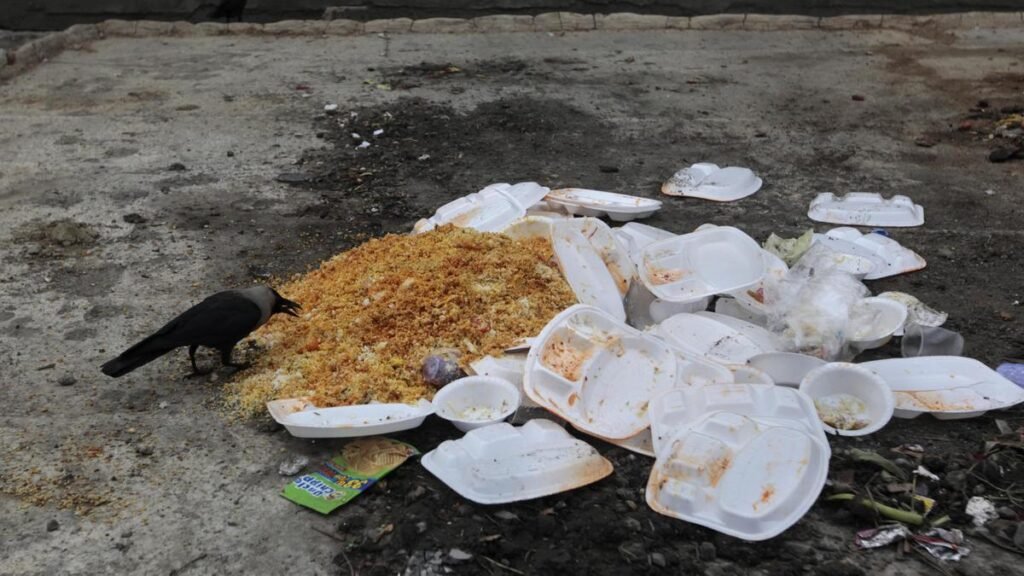
Imagine a scenario: a family has just completed their dinner and is now cleaning their table. They have some surplus food tonight, like roti and sabji. They take all the leftover food, put it in a garbage bag, and throw it away. Or imagine a wedding party or any event, where we take food on our plate beyond our capacity, and later throw away the leftover food in a dustbin. Or imagine a farmer who cultivated his crops, but they were ruined due to heavy rains during harvesting.
It’s a reality that the majority of us never eat ‘basi’ (stale) food. In urban areas, we often throw it in a garbage bag, treating it as waste. In rural or semi-rural areas, it is sometimes used as food for cattle or distributed to needy people.
All of the above examples illustrate food wastage. In this article, we discuss food wastage in India. India, one of the world’s largest food producers, also has a poor ranking in the Global Hunger Index. India produces 1372.94 lakh tonnes of food grains in 2024–2025. If we calculate how much food is required to remove hunger from our population, we find that we have enough food for everyone. The country has a surplus. But then why does India still face food security issues? The answer lies in basic economics — having enough supply is not sufficient; an efficient supply chain is equally essential.
According to the United Nations Environment Programme report, over US $1 trillion worth of food is wasted every year globally. This represents one-third of total global food production. Such food waste does not decompose systematically, affecting our environment. Moreover, the production of this wasted food involves the use of large amounts of fertilizers, water (especially freshwater), land, and labor, contributing to economic and environmental challenges such as global warming.
Types of Food Wastage
Before examining the case of India, we need to understand what food wastage is and its types. Food wastage can be classified into two categories: edible and inedible.
Edible Food Wastage
Edible food waste refers to food that could have been consumed by humans but is discarded. Items like leftover meals and expired grocery items fall into this category.
Edible food waste can be further divided by source. The first is household waste — especially in urban areas, leftover meals are thrown away instead of being utilized or properly decomposed. The second is retail waste — many food items expire before being sold and are thus discarded. Another source is agricultural waste, which occurs when crops are destroyed before harvesting due to floods, landslides, or heavy rain. The last is wastage from public events, restaurants, and hotels. Data shows that in Indian weddings, nearly 20% of food is wasted.
Inedible Food Wastage
Inedible food waste refers to food scraps that are not consumed by humans, such as fruit peels, eggshells, and bones. These mainly originate from households and the food service sector, and their impact is particularly visible in urban areas.
Now, let us look at India’s position on food wastage. India performs better than the global average, where the world’s per capita food waste is 79 kg, while India stands at 55 kg per capita. However, this still translates to 74 million tonnes of food wasted annually — around 22% of the food grain output or 10% of total food grain and horticulture production.
Case Study: Food Wastage in Urban India
Cities like Mumbai, Delhi, and Bengaluru are notorious for their love of celebrations, weddings, and conferences catering to hundreds or even thousands of people. But with grand festivities comes significant food wastage. Event managers often play it safe by over-catering, leading to mountains of uneaten food. NGOs like Feeding India step in, rescuing hundreds of tonnes of food every month from banquet halls, hotels, and residential complexes to feed the needy.
Restaurants and hotels also discard unsold food due to strict food safety rules, often throwing away perfectly edible items. Moreover, packaged foods are frequently disposed of once they reach their “best before” date, even when they remain safe to consume. Urban lifestyles, with their culture of abundance, also contribute significantly to food wastage.
Rural Food Wastage: Post-Harvest Losses
In rural areas, food wastage tells a different story. Here, the losses occur mainly during post-harvest handling and supply chain transit. Farmers lack access to basic cold storage facilities, causing fruits, vegetables, and milk to spoil during transportation. The absence of affordable storage options and modern technologies like refrigeration leaves small and marginal producers vulnerable to losses. Furthermore, issues with transportation — such as blocked routes or long distances — often result in food grains going to waste.
However, there is hope. Cooperatives and farmer-producer organizations are pioneering initiatives like solar-powered cold storage and decentralized procurement centers. These efforts have shown promising results in reducing spoilage and monetary losses. But more needs to be done to scale up these initiatives. The government and private sector must step up to support such efforts.
In addition, natural disasters such as heavy rain, floods, and landslides — which occur frequently nowadays — disproportionately affect rural areas, destroying crops and increasing food waste.
Breakdown of Food Waste by Sector
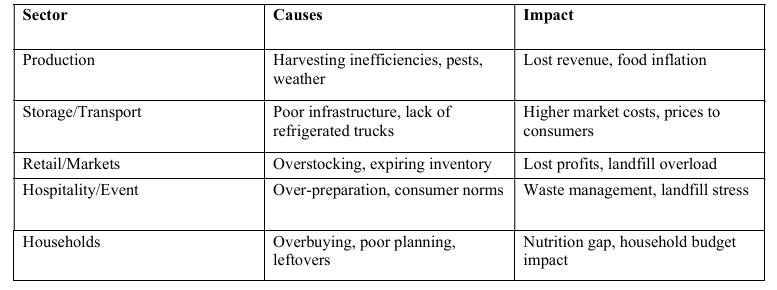
The next question is how the government addresses this problem. According to a parliamentary answer, the central government has agencies that collect and distribute surplus food. Surplus food distribution agencies operate under the Indian Food Sharing Alliance (IFSA), which has 82 registered agencies reaching over 90 cities.
However, this problem cannot be solved by governance alone — public cooperation is crucial. The Central Government has advised all States and Union Territories to add a chapter on the prevention of food wastage in school syllabi to raise awareness among students and sensitize them to this issue. The government also launched the “Save Food, Share Food” initiative to promote surplus food donation in the food industry, including among caterers. A nationwide campaign against food waste has also been initiated to raise public awareness.
Food waste represents a moral, environmental, and economic challenge that affects every section of society — farmers, retailers, hoteliers, and families alike. Reducing food waste requires coordination among the government, private sector, civil society, and individuals. Only through technological advancement, robust policy measures, and a cultural shift can India move toward a system where surplus is not discarded but redirected — toward sustainability, equity, and progress.
In September 2025, he successfully completed his internship as a Policy Researcher at Politico Insights, where he conducted extensive research on developmental policies in rural Bihar, analyzing the impact and implementation gaps in grassroots governance. His exposure to the UPSC curriculum and research experience has strengthened his understanding of public administration, social policy, and evidence-based policy design.
Soumyadeep’s work focuses on the intersection of governance, rural development, and policy innovation, with a vision to contribute meaningfully to India’s development discourse through rigorous research and informed policy engagement..